Medically reviewed by our in-house trichology committee.
The short answer
There is a real signal, and it is thinner than the marketing suggests. A 2026 network meta-analysis does place pumpkin seed oil above placebo for hair density. But the trial everyone quotes for it — the source of the famous 40% — was run using a branded multi-ingredient capsule, not pumpkin seed oil on its own. So the number is real and its attribution was never tested.
That distinction is the whole article, and it is worth ten minutes even if you already have your answer. Because the way one honest study became a global claim about one plant is the same route half the hair-loss shelf travels. Learn to spot it here and you will spot it everywhere.
If you are mainly here to decide what to buy, the practical part comes first: the only version of this product that will teach you anything in six months is the one containing a single ingredient.
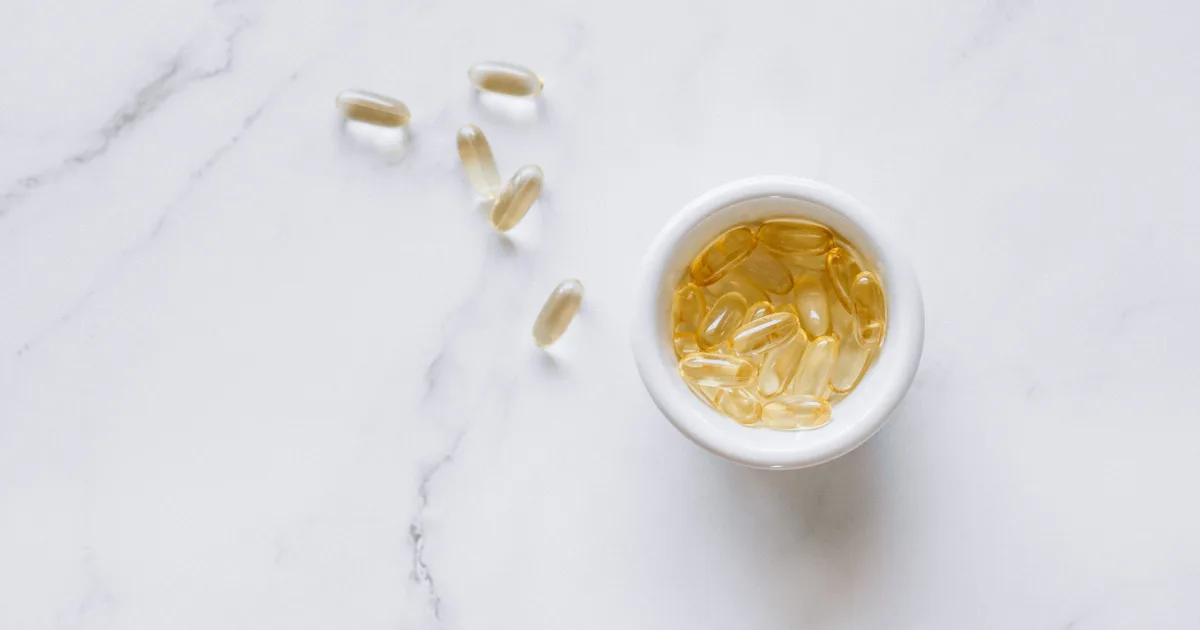
Pumpkin seed oil softgels, no blend
The only way to know, six months from now, what you actually tested · Cold-pressed and opaque packaging, because this oil oxidizes · A food supplement, not a drug, and not a substitute for medical advice
- One plant on the label — the opposite of the capsule used in the 2014 trial
- Look for the actual amount of oil per softgel, not just the plant's name
- A ten-line 'hair complex' walks you straight back into the attribution problem below
- Replaces neither a diagnosis nor a prescribed treatment
from $15
See on AmazonAffiliate link
What the 2014 trial counted
Start with the study on its own terms, because it was not a bad one.
Seventy-six men with mild to moderate androgenetic alopecia, randomly assigned to 400 mg a day of a pumpkin seed oil product or to placebo, for twenty-four weeks. Four outcome measures, which is more than most supplement trials bother with: standardized photographs scored by a blinded investigator, patient self-assessment, hair thickness, and hair counts.
What came out: hair counts rose by an average of 40% from baseline, against 10% on placebo. Self-rated improvement and satisfaction scores were higher in the treated group too. Adverse effects did not differ between the groups.
Read the wording carefully, because it does a lot of work. This is a percentage increase in hairs counted inside a marked area, measured against each man’s own starting point. It is not “40% more hair on your head,” and the gap between those two sentences is where most of the internet lives.
What was actually inside the capsule
Here is the part that almost nobody who cites this trial mentions.
The men were not given pumpkin seed oil. They were given a branded commercial capsule whose formulation combines pumpkin seed with several other plant components: octacosanol, a plant-derived fatty alcohol; evening primrose; corn silk; red clover; and tomato, for its lycopene.
Then there is the product’s own name, which contains the word Sabal. Sabal is the botanical name of the palm that saw palmetto is extracted from — the best-selling anti-androgen plant on the hair-loss shelf, whose evidence file I go through in Does Saw Palmetto Work for Hair Loss? The Honest Numbers.
Sit with that for a second. The single most-cited trial in favor of pumpkin seed oil was run with a capsule that advertised, on its own box, a different plant believed to work through the very same mechanism.
Interactive schema
What the 2014 trial actually put in the capsule
Tap any component to see what it was doing there — and what it stops you concluding.
Six components in, one number out. Pick a component above.
What this schema shows
Six things go in and one number comes out. Nothing in that design can tell you which of the six did the work, or whether it took more than one of them. The number is real. Crediting it to pumpkin seed is the part nobody measured.
The fix
If you want to try pumpkin seed, try it on its own. A single-ingredient product is not better on paper than a blend — but six months later you will know what you tested. That is the one thing the 2014 trial cannot tell anyone.
Affiliate link
Check the label for: one plant only, the actual amount of oil per softgel, and cold pressing. A twelve-line 'hair complex' puts you right back where the 2014 trial was.
💡 Thomas R.’s take: “This is not fraud, and I don’t think the authors set out to mislead anyone. They tested a product that exists on the market — which is done all the time — and they named it in their methods. The slide happened afterwards, in the citation chain. Every writer who copied the abstract dropped one more qualifier, and ten years later all that was left was the plant in the title and the number. In twelve years, that mechanism has cost my patients more time than anything else: not a fake study, a real study badly copied.”
What this does not mean is that pumpkin seed does nothing. The trial cannot settle that question either way for the ingredient alone. What it can say is that one specific blend, at one specific dose, beat a placebo over twenty-four weeks. That is genuinely something — it just isn’t what it gets quoted for.
The comment published in the same journal
The trial did not slip past its peers. The following year, the same journal ran a comment from another author who welcomed the findings and raised one precise limitation — the kind you cannot see by eye.
His argument is about seasons. Male hormone levels shift across the year, and the proportion of hairs in the growth phase shifts with them. A twenty-four-week trial — under six months — therefore sits inside a single slice of the annual cycle. He argued that a duration of at least one year was needed for that factor to cancel itself out, and called for further work on the frontal scalp and on how results vary with long-term use.
I like that objection, because it attacks neither the authors’ honesty nor their method. It simply notes that a measurement taken over six months can carry a season inside it that you will happily credit to the product. You will never read that on a product page, and it is most of the distance between a specialist’s reading and an abstract’s.
The women’s trial, and the missing arm
The second study you will see cited is a different animal: it tested the topical route, in women, and it is the source of the shelf’s boldest claim — “as effective as minoxidil.”
Published in 2021, it split sixty women with female pattern hair loss between pumpkin seed oil applied to the scalp and 5% minoxidil foam, over three months. Both groups improved on the trichoscopy measures: less variation in shaft diameter, fewer vellus hairs, and more upright regrowing hairs in the oil group.
Now look at the design. There was no placebo arm. Two active products were compared against each other, and both improved — which is exactly what you would expect, and which does not license the conclusion drawn from it. With no control, nobody knows what daily scalp massage alone would have delivered over a quarter, or the regularized washing, or simply the attention paid to your hair when you are enrolled in a study.
Three further limits are worth holding: three months is short for a hair cycle, sixty participants is few, and trichoscopy measures structural indicators rather than counting hairs over time. None of this disqualifies the work. It locates it — an exploratory signal, not a demonstrated equivalence with a drug whose file runs across decades, which I cover in Minoxidil 5% for Men: Protocol, Results & Shedding Phase Explained.
Where the 2026 meta-analysis puts it
It would be easy at this point to tip into blanket skepticism. That would be its own kind of dishonesty, and the recent data does not allow it.
In January 2026, a systematic review with network meta-analysis pooled nineteen randomized trials, one thousand six hundred and fifty-eight people with androgenetic alopecia, and sixteen different supplements. The value of a network meta-analysis is that it can rank products that were never tested head-to-head.
Its finding, for our purposes: pumpkin seed oil is among the six interventions that significantly outperformed placebo on hair density, and among those scoring best on blinded physician assessment of regrowth. Tolerability across the supplements reviewed was described as good.
So here is the full picture, and it is more nuanced than either available caricature. This is not an inert product: a signal exists, it survives a methodical synthesis, and it sits on the right side of zero. It is also a thin signal, drawn from a set of small trials whose limits the review flags itself, resting on a founding study that did not test the ingredient alone.
If I had to compress it into one sentence: pumpkin seed is a serious candidate that has been poorly studied, not a proven treatment. Those are two different things to buy, and to hope for.
A mechanism is not an outcome
That leaves the “how,” which is the part the shelf will use to convince you. A 2024 review from a university medical center attributes the presumed effect of pumpkin seed oil to two routes: inhibition of 5-alpha-reductase by beta-sitosterol and linolenic acid, and a reduction in interleukin-6 activity.
It is plausible, it is coherent, and it is exactly where you should get careful. 5-alpha-reductase is the enzyme that converts testosterone into DHT, the hormone that miniaturizes susceptible follicles — the central mechanism of pattern baldness. Any compound that slows it down, even slightly, therefore has a story to tell.
But a story is not a measurement. Finasteride inhibits that same enzyme, with a potency and a clinical file that bear no comparison, and it remains a prescription drug with its own trade-offs — a subject I take on fully in Finasteride for Hair Loss: What the Evidence Actually Shows. Between “inhibits 5-alpha-reductase in a dish” and “grows hair on heads” lies the whole distance the supplement aisle spends its life inviting you to cross for free. It is the same logical jump sitting behind Does Biotin Work for Hair Loss? What It Does, and What It Distorts, and behind half the claims on the shelf.
So the useful question never changes: what was counted, in how many people, for how long, and against what?
Softgel or oil: what you are buying
Everything above describes groups. You have a timeline, a pattern of loss, and possibly something already in your cart. Three questions are enough to tell whether the thing you are eyeing makes sense in your case — and often, to move your attention somewhere it will do more good.
Selector · 3 questions
Softgel, oil, or neither?
Question 1 of 3
What does your hair loss look like?
💡 Decision grid built by Thomas R., hair restoration specialist, from the trials cited at the end of this article. It points you somewhere; it does not diagnose. Any supplement is a decision to make with your doctor or pharmacist.
Two label habits, whatever your profile.
On a softgel, look for the actual quantity of oil, not merely a mention of the plant. Ingredients are listed in descending order of quantity: a “pumpkin seed extract” line sitting tenth in a complex weighs very little, and you are mostly paying for the other nine.
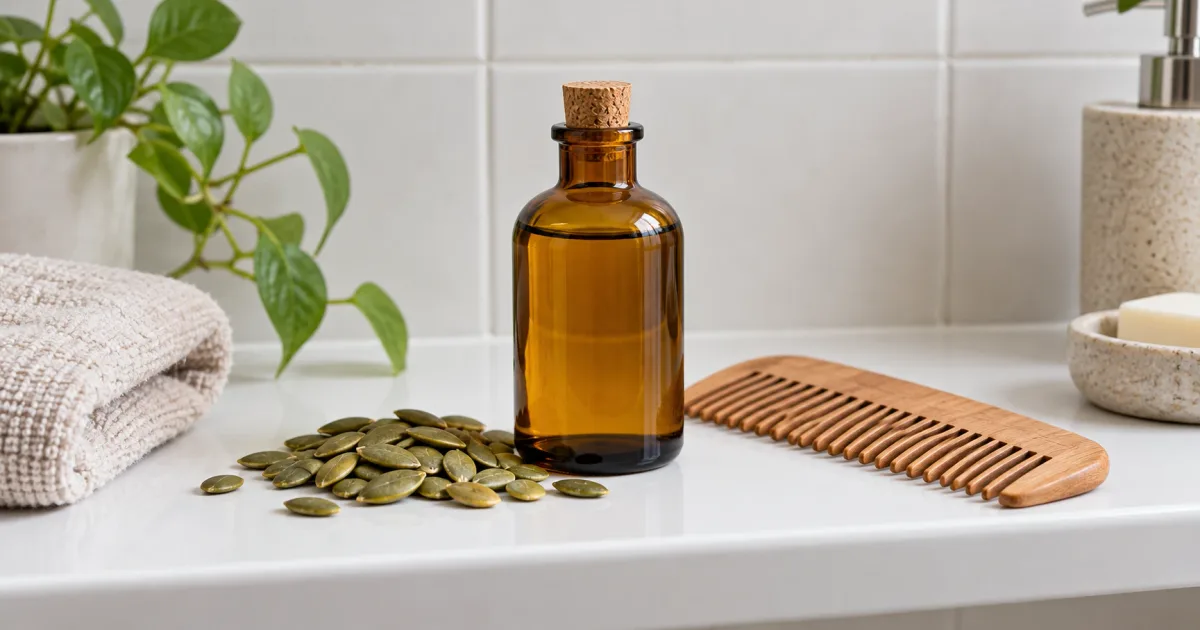
On a bottle, want a virgin, cold-pressed oil, no added fragrance, in amber or opaque glass. An oil rich in unsaturated fats oxidizes in light, and an oxidized oil has little left to offer a scalp — mostly a smell that will make you quit after three weeks.
Limits, and when to see a doctor
Four limits, said plainly.
The file is thin, and I am not going to pad it. A founding trial run with a blend, a topical trial with no placebo arm, a favorable but cautious meta-analysis: that is not much for a product sold as an alternative. If you want the strongest evidence available for pattern hair loss, it is not here.
It is not a drug, and it is not nothing either. A food product you expect to act on a hormonal pathway deserves to be mentioned to a clinician, like any supplement. In pregnancy, while breastfeeding, alongside any hormonal treatment, or with a known allergy to gourds and squash, ask before opening the bottle rather than after.
No number in this article is a dose. The 400 mg a day quoted above describes what one 2014 trial used. It is not a recommendation and not a validated amount for you. This site does not prescribe, and that decision belongs with your doctor or pharmacist.
Nothing here is a diagnosis. Androgenetic alopecia, telogen effluvium, alopecia areata and iron deficiency look alike from a distance and call for unrelated management. Sorting them happens in a consultation, with a scalp examination and sometimes a few blood tests — the starting point of Chronic Telogen Effluvium: Recovery Timeline & Treatments for diffuse shedding.
Some presentations need prompt attention regardless of any of the above: sudden heavy shedding, sharply defined bald patches, a red or painful scalp, or associated systemic signs such as unusual fatigue, marked weight change, or cycle disruption. No supplement should be used to keep those waiting.
Frequently asked questions
Can pumpkin seed oil replace minoxidil?
No, and the claim traces to a trial that could not support it: three months, sixty participants, no placebo arm. Two products both improving does not make them equivalent, especially when one carries decades of trials behind it and the other a few months. Swapping a treatment is also not a decision to take from an article, including this one.
Should I swallow it or rub it in?
Two separate evidence files, and the distinction matters: the oral route carries the placebo-controlled trial, the topical route carries the trial without a placebo. Neither has been compared to the other. Pick one, and don’t count the other’s evidence in its favor.
How long before I can judge?
Six months minimum, with dated photos in the same framing and the same light. A hair cycle will not be read in four weeks — and the author of that 2015 comment thought a full year was needed just to escape the effect of the seasons.
Does it work on a receding hairline?
Nobody really knows, and that is one of the exact gaps the 2015 comment asked researchers to fill. The frontal hairline is the hardest zone to recover whatever the product, a point I get into in Which Dermaroller for a Receding Hairline? (Sizes, Frequency & Common Mistakes).
What about women?
The only work in that setting is the 2021 topical trial, with the limits described above. Female hair loss reads differently — iron status, thyroid and hormonal ground come first — and the path starts with a workup, not with choosing an oil.
Why do so many sites say the opposite of this article?
Because they copy an abstract instead of opening the paper. The abstract says “pumpkin seed oil” and “40%”; the methods section names the product and its composition. Both facts live in the same document, but only one of them travels.
Can I just cook with it instead of buying capsules?
Pumpkin seed oil is a food, and there is nothing wrong with using it in the kitchen — unheated, since it handles heat poorly. Just don’t conflate the two things: no trial has counted hairs in people dressing their salads with it, and the quantities are nowhere near comparable.
Sources and references
- Cho YH, Lee SY, Jeong DW, et al. — Effect of Pumpkin Seed Oil on Hair Growth in Men with Androgenetic Alopecia: A Randomized, Double-Blind, Placebo-Controlled Trial. Evidence-Based Complementary and Alternative Medicine, 2014;2014:549721. DOI 10.1155/2014/549721. Randomized placebo-controlled trial, 76 men, 400 mg/day of a pumpkin seed oil product for 24 weeks; mean hair count increase of 40% versus 10% on placebo. Registered as NCT01852487. The product administered was a branded commercial capsule combining several plant components, not pumpkin seed oil alone.
- Verma H. — Comment on “Effect of Pumpkin Seed Oil on Hair Growth in Men with Androgenetic Alopecia: A Randomized, Double-Blind, Placebo-Controlled Trial”. Evidence-Based Complementary and Alternative Medicine, 2015;2015:271474. DOI 10.1155/2015/271474. Comment published in the trial’s own journal: at least one year of follow-up would be needed given seasonal variation in male hormone levels and its effect on the anagen phase; calls for work on the frontal scalp and on prolonged use.
- Ibrahim IM, Hasan MS, Elsabaa KI, Elsaie ML. — Pumpkin seed oil vs. minoxidil 5% topical foam for the treatment of female pattern hair loss: A randomized comparative trial. Journal of Cosmetic Dermatology, 2021;20(9):2867–2873. DOI 10.1111/jocd.13976. Randomized comparative trial, 30 participants per arm, 3 months, trichoscopic endpoints. No placebo arm.
- Ufomadu P. — Complementary and alternative supplements: a review of dermatologic effectiveness for androgenetic alopecia. Proceedings (Baylor University Medical Center), 2024;37(1):111–117. DOI 10.1080/08998280.2023.2263829. Review of complementary and alternative medicines in androgenetic alopecia; mechanism attributed to inhibition of 5-alpha-reductase by beta-sitosterol and linolenic acid, and to reduced interleukin-6 activity.
- Zhou L, Zhu W, Chen Y. — Effects of dietary supplements on androgenetic alopecia: a systematic review and network meta-analysis. Frontiers in Nutrition, 2026;12:1719711. DOI 10.3389/fnut.2025.1719711. Systematic review and network meta-analysis: 19 randomized trials, 1,658 patients, 16 interventions; pumpkin seed oil among the six interventions significantly outperforming placebo on hair density, with good overall tolerability.