Medically reviewed by our in-house trichology committee.
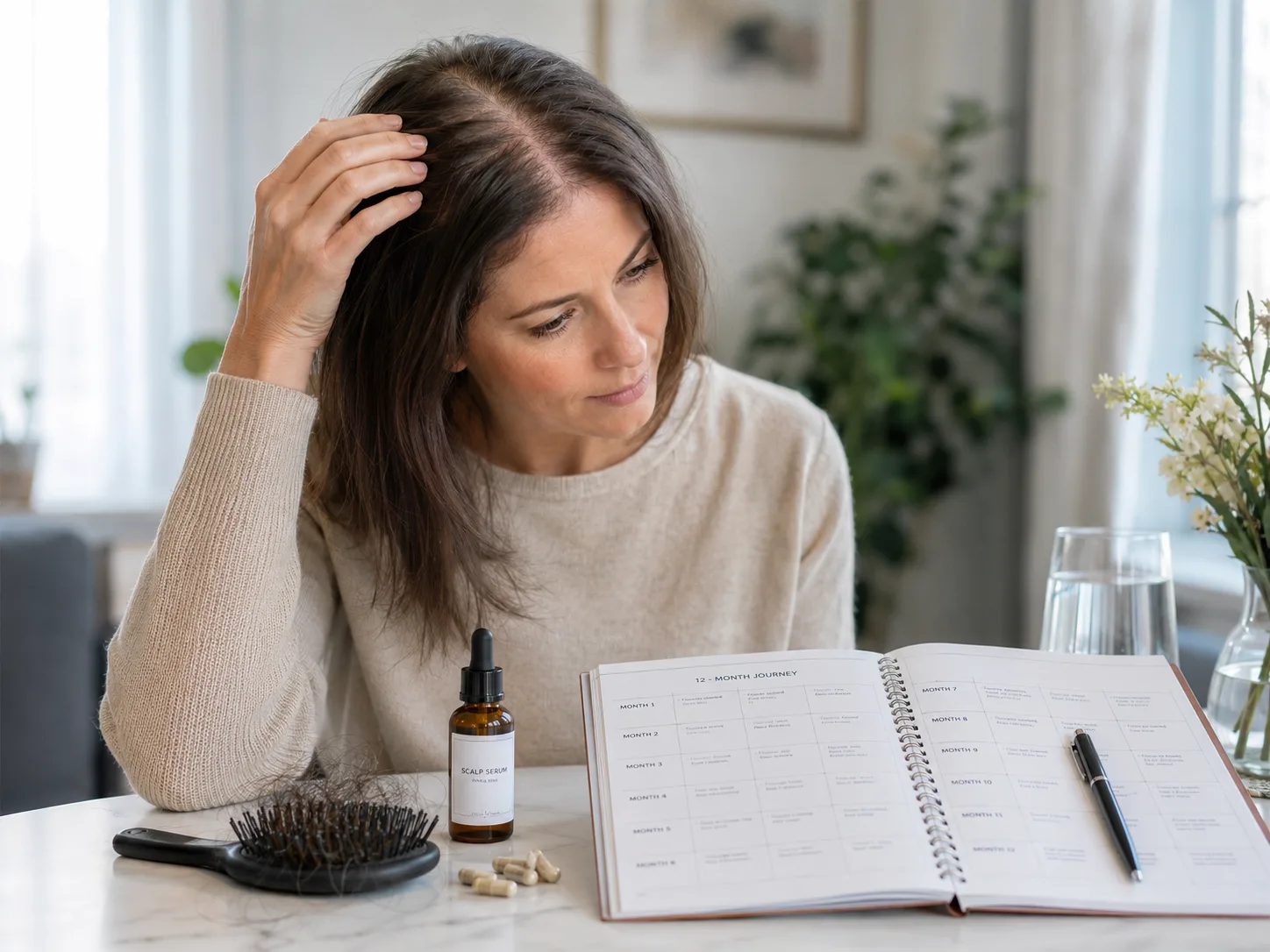
Helen went to the doctor three times before anyone asked the right question.
Her hair had been shedding since the fall. First round of blood work: thyroid off, hormone numbers frankly abnormal. Repeat the panel, maybe see an endocrinologist. Except she had none of the symptoms — no racing heart, no tremor, no weight loss. Just hair in the drain and a lab report saying something else entirely.
The right question came at the third appointment: “are you taking anything for your hair?”
She was. Four months of a bottle bought online, dosed at a level no plate of food will ever deliver.
It wasn’t her thyroid. It was her biotin. And the uncomfortable part of the story is that she’d done exactly what the internet told her to do.
How biotin ended up on the hair aisle
Biotin — vitamin B7, sometimes labeled B8 — is an enzyme cofactor. It shows up in the metabolism of fatty acids, glucose and certain amino acids. Nothing in that job description says “hair.”
The link runs the other way, through deficiency. When biotin genuinely runs short, skin and hair are where it announces itself: rash around the eyes, nose and mouth, splitting nails, thinning hair, sometimes neurological signs. That clinical picture is real and well described.
From there the folk logic wrote itself. If too little makes hair fall, more must make it grow. It’s the same leap people make with water: dehydration dries out your skin, therefore a gallon a day buys you a complexion.
The flaw is the premise. That reasoning assumes a shortfall most people don’t have. Biotin is in eggs, liver, fish, legumes, nuts, seeds and several vegetables, and gut bacteria produce some of it too. The NIH Office of Dietary Supplements is blunt about it: biotin deficiency is rare, and severe deficiency has never been reported in healthy people eating an ordinary mixed diet.
💡 Thomas R.’s take: “I usually ask people how often they eat eggs. It isn’t a nutrition consult — it’s a way of pointing out that they’re paying for a vitamin they already swallow. With hair supplements the biotin is almost never the real story. The real story is whatever else is in the bottle, and what nobody looked for before buying it.”
Eighteen cases, not one of them healthy
There’s one review that goes straight at this question, and it summarizes fast.
In 2017, Patel, Swink and Castelo-Soccio published a review in Skin Appendage Disorders on biotin use in hair loss. They collected the published cases where biotin supplementation was followed by improvement in hair or nails: eighteen of them. Every single patient had an underlying condition explaining the poor growth — inherited disorders of biotin metabolism, malabsorption, medications that interfere with biotin, severely restricted diets.
So: biotin fixed a shortfall, every time there was a shortfall to fix. That’s reassuring about the pharmacology. It is also completely silent on the case that concerns almost everyone reading this — someone who eats normally and is losing hair anyway.
A 2024 update in the Journal of Clinical and Aesthetic Dermatology went back over the same file and landed in the same place: the evidence supporting biotin in people without documented deficiency is thin, in inverse proportion to the shelf space.
Almohanna and colleagues, writing in Dermatology and Therapy in 2019, widened the frame to vitamins and minerals across non-scarring alopecia. Their review is worth reading because it cools things down in both directions. It doesn’t say nutrition is irrelevant to hair — iron status in particular keeps coming back — but it makes the case that supplementing blind, with no proven deficit, has no solid basis and isn’t automatically harmless.
What’s missing here isn’t some brilliant study nobody has read. It’s a controlled trial in adults who aren’t deficient, with objective density measurements. Thirty years of commercial success haven’t produced one.
The same pattern holds for most other “natural” supplements on the same shelf — pumpkin seed oil is another example: a mechanism that explains itself well, and a level of proof that matches the mechanism, not the marketing promise.
What the label is actually allowed to say
Turn your bottle around and read the fine print. In the United States it will say something close to supports healthy hair, skin and nails — and then, in smaller type, the sentence that matters: this statement has not been evaluated by the Food and Drug Administration. This product is not intended to diagnose, treat, cure, or prevent any disease.
That disclaimer isn’t legal decoration. It’s the price of making a structure/function claim without having to prove it first. Dietary supplements don’t go through pre-market approval the way drugs do; the manufacturer is responsible for the claim, and “supports” is doing a lot of quiet work. Supports what, compared to what, in whom — none of that is answered, and none of it has to be.
Europe took a different route to a similar place. Under EU Regulation 432/2012, one authorized wording exists, locked word for word: biotin contributes to the maintenance of normal hair. Read it slowly. “Maintenance” is not growth, and certainly not regrowth. “Normal hair” means hair that’s fine already — if yours is falling out, you’ve stepped outside the sentence. And the claim attaches to the nutrient, not to any particular product or heroic dose: an ordinary tablet and a megadose bottle print the same phrase with the same right.
Two regulatory systems, two very careful sentences, and the same fate. Both got quoted on product pages as proof of something neither one says.
Biotin (Vitamin B7) — Moderate Strengths
The category to prefer if you want to supplement anyway · Ordinary strengths cover intake without the megadoses that scramble lab tests · Always disclose it before blood work
- Covers intake without dose escalation
- High doses show no proven added benefit
- Tell your doctor and the lab you take it
- Replaces neither a workup nor a treatment
from $12
View on AmazonAffiliate link
The real risk: it distorts your blood work
Here’s the part no product page mentions, and it’s the only part that can actually hurt you.
A great many routine blood tests are immunoassays built on the biotin-streptavidin binding pair. It’s an elegant piece of chemistry and it’s been in laboratories for decades. It has one weakness: if the patient’s own blood is loaded with biotin, that biotin competes with the reagent. The result comes out wrong. Not flagged, not obviously broken — wrong, and entirely presentable.
The FDA issued a safety communication about this, updated in November 2019. Two things in it are worth carrying around.
First, the doses. The agency notes that supplements marketed for hair, skin and nails can contain biotin at levels far above the recommended daily intake — by a factor in the hundreds. These aren’t food-level amounts. That’s what makes the interference possible in the first place.
Second, the stakes. The FDA singled out falsely low troponin results — troponin being the marker used to diagnose a heart attack — and reported a patient on high-dose biotin who died after a falsely reassuring troponin result. That is not a theoretical risk, and it is also not an everyday one: it’s a rare event in a grave situation, which is the worst possible combination.
The version that will affect more readers, though, is Helen’s. Thyroid assays are widely involved: depending on the platform, excess biotin can push thyroid hormone values falsely up and TSH falsely down, drawing a picture of hyperthyroidism on paper in someone who has none. Published cases include patients worked up for Graves’ disease on the strength of numbers their supplement produced. Endocrinology societies advise stopping biotin for a few days before thyroid testing — the exact interval depends on the lab and the assay, which is why it’s the lab or your doctor who should give it to you, not a blog.
Sit with the irony for a second. Someone shedding hair takes biotin for it. Their doctor, entirely correctly, orders a thyroid panel — one of the first things to rule out in diffuse hair loss. And the supplement bought for the hair is what makes the test that might have explained the hair loss unreadable.
💡 Thomas R.’s take: “The rule is simple and free: when someone orders blood work, list everything you swallow, supplements included. Not just prescriptions. A ‘hair, skin and nails’ gummy is not a neutral snack as far as the laboratory is concerned, and the phlebotomist can’t guess what’s in your bathroom drawer.”
Quick test: is this worth it in your case?
Three questions, one straight answer. Of the five possible outcomes, exactly one points you toward buying anything — the other four send you somewhere better, and they’re the common result.
Test · 3 questions
Is biotin worth it in your case?
Question 1 / 3
Do you have blood work coming up, pending, or recently done?
💡 Decision grid built by Thomas R., hair restoration specialist. It points you somewhere; it does not diagnose. Reading a blood panel and deciding on any supplement is your doctor's job.
What to chase instead
Dropping biotin leaves an obvious gap: replace it with what? The honest answer is a line of reasoning, not another bottle.
Iron status is the best-documented nutritional lead, particularly in women. The literature on non-scarring alopecia keeps circling back to it, and it’s a parameter you can actually measure — ferritin, blood count, clinical context. It’s also one you can’t correct by guesswork: too much iron isn’t harmless, and supplementing is a decision made after a test, with a clinician. Our guides to postpartum shedding and chronic telogen effluvium walk through the process.
Thyroid function is the other big driver of diffuse shedding that a panel can settle — provided, as we’ve just seen, that the panel is readable.
Hormonal and medication context matters at least as much: recent pregnancy, menopause, stopping birth control, surgery, crash dieting, a bad fever. Diffuse shedding that starts two or three months after an event like that often tells the whole story by itself.
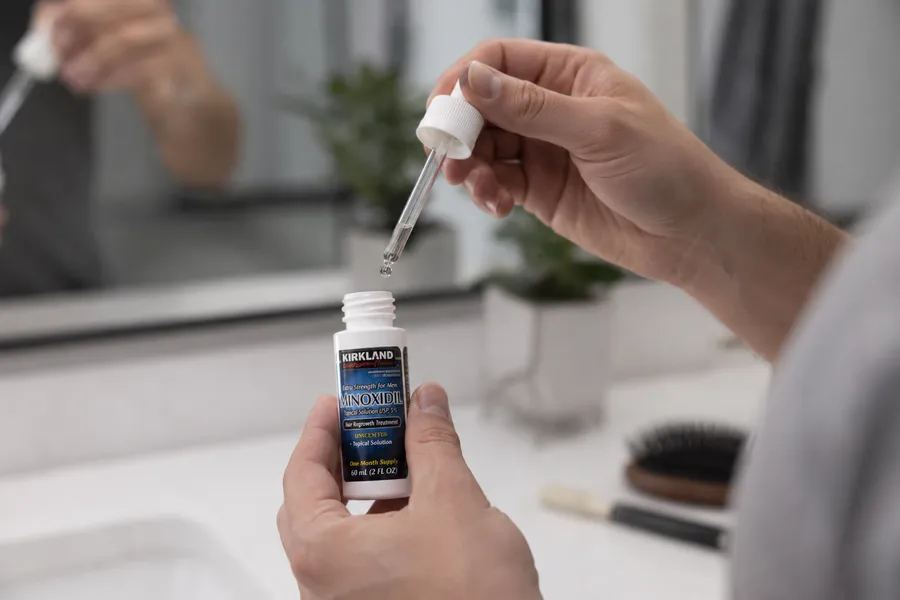
And if the pattern is androgenetic — receding temples, thinning crown, hair getting finer year over year — no vitamin changes the trajectory. That isn’t an intake problem, it’s follicle sensitivity to androgens. The documented levers are elsewhere: topical minoxidil, prescribed treatments, and catching it early rather than spending a year on capsules.
Then there’s the case where a workup did show a genuine shortfall. Supplementing then makes sense — the sense the 2017 review documented: correcting a real deficit. That call belongs to the clinician who read your results, not to an article and not to a product page.
Iron + Vitamin C Supplements
The best-supported nutritional lead in diffuse shedding, especially in women · Only worth considering after blood work and on medical advice · Iron is not a 'just in case' supplement
- The nutritional factor most often implicated
- Measured by a blood test, not by feel
- Excess iron carries real risk
- A medical decision, not a shopping decision
from $16
View on AmazonAffiliate link
Limits, side effects, and when to see a doctor
Biotin has a reputation for being harmless, and on direct toxicity that reputation is largely earned: the excess leaves in your urine and reported adverse effects are uncommon. The danger isn’t in what it does. It’s in what it hides.
A few principles I repeat without getting tired of them:
- A supplement is not a diagnosis. Androgenetic alopecia, telogen effluvium, alopecia areata and iron deficiency look alike from a distance and are treated very differently. Six months on capsules is six months of not finding out which one you have.
- Always disclose supplements before blood work. It’s the one line in this article that can save you from a real problem.
- Don’t stack bottles. Plenty of “hair, skin and nails” formulas already contain biotin, zinc and selenium. Running two products at once doubles intakes nobody is tracking — and selenium in particular is unforgiving of excess.
- Pregnancy, breastfeeding, ongoing treatment, chronic illness: ask before you buy, not after.
- Don’t change anything on your own initiative. Adding, dropping or swapping a prescribed treatment belongs to whoever prescribed it. Finasteride in particular is a prescription-only medicine, with side effects worth knowing about and an absolute contraindication in pregnancy — that’s a conversation for a doctor. Minoxidil is a medicine too, with its own effects and its own early shedding phase.
Some signs belong to no supplement and need a prompt opinion: sudden heavy shedding, sharply defined bald patches, a scalp that hurts or stays red, or associated symptoms — unusual fatigue, feeling cold, cycle changes, unexplained weight change. Those point toward alopecia areata, a thyroid disorder, a deficiency, or a systemic illness. They call for a primary care doctor, a dermatologist or an endocrinologist, and no capsule substitutes for that exam.
Frequently asked questions
Does biotin regrow hair?
In someone genuinely deficient, correcting the shortfall improves hair and nails — that’s what the published cases show. In someone eating a varied diet with no deficiency, there’s no solid demonstration of a regrowth effect. So the useful question isn’t “does it work,” it’s “do I have a shortfall to correct” — and that gets measured, not guessed.
How long before I’d see anything?
If biotin is correcting a real deficit, improvement follows the pace of hair itself: months, not weeks. If you’re not deficient, no amount of waiting produces an effect that has no reason to occur. Checking the mirror every morning is the best way to lose the plot.
I already started a supplement and I have blood work next week.
Say so — to the doctor ordering it and to the lab drawing it. Don’t decide on your own to stop anything: it’s for the professional to decide whether to space the dose, move the appointment, or run an assay that isn’t biotin-sensitive. A wrong result costs far more than one sentence said at the right moment.
Are all “hair, skin and nails” products affected?
Not all, but many. What matters is the biotin figure on the label, not the name on the bottle. A formula that stays near ordinary intake isn’t the same proposition as one dosed hundreds of times higher — and the latter is common on the hair aisle.
What if I barely eat biotin-rich foods?
Very restricted eating, digestive malabsorption, some long-term medications, or a habit of raw egg whites can genuinely affect biotin status. Those are conversations for a doctor, maybe a dietitian — not boxes to tick before self-prescribing a bottle.
What about biotin shampoos and serums?
Different question again: nothing establishes that biotin applied to the scalp crosses the skin in any useful amount. If you like a product, judge it on how it washes and how your scalp tolerates it — the ground rules from our piece on active shampoos apply here too.
Sources and references
-
Patel D.P., Swink S.M., Castelo-Soccio L. — A Review of the Use of Biotin for Hair Loss — Skin Appendage Disorders, 2017;3(3):166-169. PubMed Central
-
Yelich A., Jenkins H., Holt S., Miller R. — Biotin for Hair Loss: Teasing Out the Evidence — The Journal of Clinical and Aesthetic Dermatology, 2024;17(8):56-61. JCAD
-
Almohanna H.M., Ahmed A.A., Tsatalis J.P., Tosti A. — The Role of Vitamins and Minerals in Hair Loss: A Review — Dermatology and Therapy, 2019;9(1):51-70. DOI
-
National Institutes of Health, Office of Dietary Supplements — Biotin: Fact Sheet for Health Professionals. ODS
-
U.S. Food and Drug Administration — UPDATE: The FDA Warns that Biotin May Interfere with Lab Tests: FDA Safety Communication, November 5, 2019. FDA
-
European Commission — Regulation (EU) No 432/2012 establishing a list of permitted health claims made on foods — claim “biotin contributes to the maintenance of normal hair”. EUR-Lex
Scientifically validated by our committee of trichology experts. This article does not replace a medical consultation.