Medically reviewed by our in-house trichology committee.
The short version
Hair building fibers work. They also fail completely, for a reason nobody prints on the jar.
They work where hair is still growing and simply too fine or too sparse to hide the scalp. They fail over skin that has gone bald, because the entire product depends on having a hair to stick to. Almost every furious one-star review you will read online is the second case, bought in the hope of the first.
So the honest answer to “do they work” is: yes, as makeup, for one day, on a zone that still has hair. Everything below is how to tell which of those two situations you are in, and what to buy for each.
What the label is allowed to say
Start here, because it is the fastest test you can run in a store, and it costs nothing.
Under the Federal Food, Drug, and Cosmetic Act, a cosmetic is defined by intended use: something applied to the body for cleansing, beautifying, promoting attractiveness or altering the appearance. A drug is defined by a different intended use: diagnosing, curing, mitigating, treating or preventing disease, or affecting the structure or any function of the body.
The FDA draws the line in plain language, and it draws it exactly across this aisle. Hair growers and hair loss prevention products are drugs. A claim that a product will restore hair growth makes it a drug, no matter how it is marketed.
Which gives you a one-line filter. A jar that talks about coverage, volume, the look of density — that product is operating inside its category. A jar that talks about waking up follicles or stopping shedding has stepped outside its legal status, and that tells you something about the rest of the label too.
European rules land in the same place from the other direction. The regulation covering cosmetics there defines them as products meant to clean, perfume, change the appearance of, protect or keep in good condition the external parts of the body, hair included. Change the appearance. That is the whole mandate, and it is exactly what a fiber does.
Products that are allowed to talk about regrowth are drugs, with side effects, contraindications and in some cases a prescription. That is a different aisle, covered in Minoxidil 5% for Men: Protocol, Results & Shedding Phase Explained.
Why a fiber sticks, and to what
The mechanism is simple, and it explains every limitation that follows.
The particles in the jar are keratin, usually from wool — some products use rice keratin, rayon or human hair. Those particles carry a positive electrical charge. Your hair carries a negative one. They attract, and the powder coats the visible length of every shaft it lands near.
What you get is not regrowth. It is a change in apparent diameter: a fifty-micron hair dressed in particles reads as twice that. Do it across the few hundred hairs of a thinning zone and the pale background stops showing between them. The eye no longer finds gaps, because it no longer finds scalp.
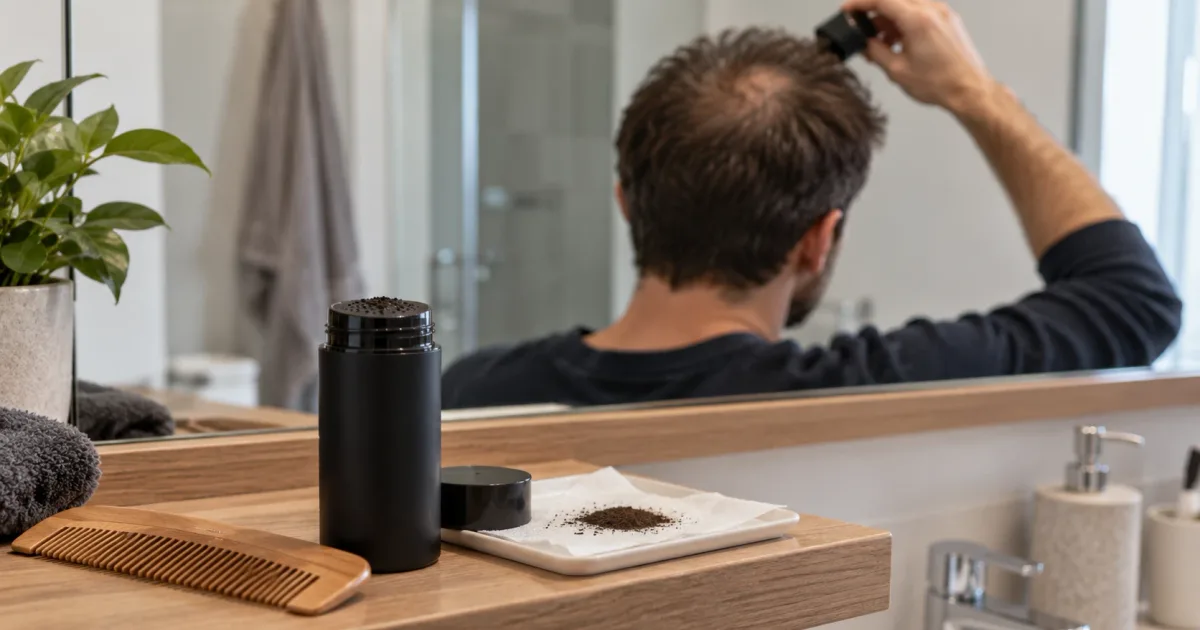
Two free details change the result more than the brand does. The powder goes on dry, clean hair — on greasy hair it clumps, and clumps are visible across a room. And you tap the jar from a distance rather than pour, then comb it through; pouring gives you a dark patch in the middle and nothing around it.
Keratin hair building fibers
Charged particles that bond to the hair you still have and raise its apparent diameter · Immediate, and rinses out with shampoo · Treats nothing: this is a cosmetic, not a medication
- Works on a thinning zone, not on skin that has gone bald
- A shade lighter than your own colour reads truer than an exact match
- Dry clean hair, tap from a distance, comb it through
- No action on the follicle and none on the cause of your hair loss
from $20
See on AmazonAffiliate link
The hard rule: no hair, no hold
A 2016 review in the International Journal of Women’s Dermatology states it without hedging: topical hair fibers require existing hairs to bind, and are therefore ineffective over bald areas.
One sentence, and it saves every second purchase in this category.
Thinning is not bald. In the first case shafts are still there — fine, short, washed out, but present — and each one is an anchor. In the second there is nothing for the powder to bond with: it sits flat on skin, creases at the forehead, darkens at the first drop of rain and leaves at the first brush of a hand. No adjustment to how much you apply fixes that.
The diagram below puts the four zone states side by side, with what the powder finds in each.
Interactive diagram
What the fiber finds to cling to, zone by zone
Tap a zone state to see what happens when the powder lands on it.
Four states, four different answers. Pick the one your own zone looks like.
What the diagram shows
The whole thing comes down to one line: a keratin fiber is pulled toward hair, not toward scalp. The more shafts a zone keeps, the more natural the result looks; the fewer it keeps, the more the powder works against nothing. And on frankly bare skin, no amount of careful application makes up for the missing support.
The correction
It is free, and it comes before the purchase: look at the zone in daylight, comb in hand, and ask whether hair is still there or only skin. If hair is there — fine, pale, it does not matter — the fiber has something to grip and this is the category to try. If it is not, change aisle rather than dose: a powder that tints the scalp, a partial hairpiece or micropigmentation answer that case, and a fiber never will.
Affiliate link
What it does: optically thicken hair that is already there, for one day. It is not a treatment, it does nothing to the follicle, and it rinses out with shampoo.
One in-between case deserves its own note, because it is common and badly served: the zone where only downy hair is left. Short, pale, spread out. Those are anchors, but poor ones, unable to hold enough pigment to bridge the gap between them. The usual result is a zone that darkens in blotches, because pigment ends up on skin. Here the right product is the one aiming at the background, not the one aiming at the shaft.
And a point that is not cosmetic at all: a thinning area filling up with short downy hairs is what miniaturization in progress looks like. That is worth showing someone, and sooner beats later — today’s fine hairs are the ones there is still something to keep. That ground is covered in How to Thicken Fine Hair: The Ultimate Guide for Women (Routine + Science) and, for younger men, in Balding in Your 20s: 5 Early Signs & How to Stop It.
Five families, five different targets
A 2012 review in the Dermatology Online Journal sorted this shelf, and its classification is still the clearest one available. It separates five families of temporary camouflage, and they are not aiming at the same thing.
Fibers, as above: they bond to hair and thicken it.
Powder cakes — discs of pigment pressed on with a sponge, then distributed by brushing the hair. They are not trying to thicken anything. They cut the colour contrast between a pale scalp and darker hair. Different strategy, and on some zones it wins.
Tinted lotions and sprays, chasing the same goal as the cake through a different vehicle: wetter, more opaque, often tougher once dry.
Hair crayons, finally, for detail work — a root that shows, the edge of a hairline, a fine scar.
Hold on to the opposition, because it decides your purchase. A fiber works on the hair. A powder, lotion or spray works on the background. The more hair your zone keeps, the better the first. The more it has lost, the more the others take over.
💡 Thomas R.’s take: “The first thing I ask is never which brand. It is: show me the zone in daylight. In twelve years I have never seen someone disappointed by fibers on a zone that still had hair. I have seen plenty of people blame the product after buying it for a patch of smooth skin, where nothing in this category could have worked. The bad purchase here almost never comes from the jar.”
Sweat, rain, pillowcase
This is what product pages skate over, and what decides whether the jar stays in your cabinet.
The material resists water once applied, and comes off with shampoo. Both are true at once, which is less contradictory than it sounds: it holds dry and under moderate damp, but the line between holding and running is thin. That line sits in a step almost everyone skips — setting it.
A hairspray passed over after application, from about eight inches, seals the particles onto the shaft. Without it, one sweating forehead sends pigment toward your temples and then your collar. With it, a shower of rain becomes survivable. Pools and salt water, though: no. Sealed or not.
Strong-hold setting spray
Passed over after the powder, it seals the particles onto the shaft · Changes how it survives sweat and light rain · Does not make the product swim-proof
- Order matters: dry hair, powder, comb, then spray from eight inches
- Two light passes rather than one heavy one — a crust shows
- Without setting, pigment travels to your temples and your collar
- Pool, ocean, shower: the powder leaves, and it is designed to
from $12
See on AmazonAffiliate link
Three everyday constraints, worth settling before they surprise you.
Pale fabric. A white collar and a dark powder meet eventually. A wipe in your bag turns that into an anecdote.
The pillowcase. This does not survive the night, and a light pillowcase will say so before you do. Rather than hope otherwise, decide when it comes off: a wash that evening, a gentle shampoo, nothing lingering. A dark towel and a dark pillowcase handle the rest.
Close range. From three feet, head-on, a camouflaged hairline is judged on its edge, not its colour. A clean border where the hair stops is what gets noticed — which is why practitioners treat that edge with something that tints the scalp, faded into a gradient, rather than with fibers alone.
Which one for your zone
Everything above describes categories of product. You have one specific zone, in one specific state, and a day to get through. Three questions are enough to establish what to buy — and, in one case in four, what not to.
Selector · 3 questions
Fibers, powder, or neither?
Question 1 of 3
Which zone bothers you in photos?
💡 Reading grid built by Thomas R., hair restoration specialist, from the reviews cited at the end of this article. It points you at a cosmetic product: it diagnoses nothing and does not replace a dermatologist's read on why you are losing hair.
What the survey actually found
These products get talked about with a certain contempt, as though they were a frivolity. The available numbers say otherwise.
A 2017 survey published in the Journal of the American Academy of Dermatology polled 359 people online, 348 of whom reported hair loss. Close to eight in ten were using a camouflaging agent, and topical hair building fibers led the list, ahead of hairpieces and wigs. Among respondents, more than eight in ten said the products improved their appearance, and around seven in ten said they improved their self-esteem.
Two caveats, because the numbers get quoted without them. These are self-reports, not measurements. And participants signed themselves up through hair loss forums and blogs, which describes a population already deeply invested in the subject rather than the general public. The finding still matters: use is widespread, and the people using it find it worth the trouble.
Then there is the part I will not soften. Effective camouflage removes the thing that was prompting the worry, and that is not harmless: I have seen consultations postponed two years because the zone had stopped showing up in photographs. The follicles involved carried on in the meantime. Camouflage and treatment are not competing — the first handles this morning, the second handles the next five years. There is no reason to choose, and a bad reason to delay the second.
For women after childbirth the timeline is different and far more reassuring: density usually returns on its own, and camouflage only has to cover the gap. The markers are in Postpartum Hair Loss: When Should You Actually Worry?.
And for anyone who settles the question with a cap instead of a powder: that is free, instant, and harms nothing. The fear attached to it — that wearing a hat causes baldness — was taken apart in Does Wearing a Hat Cause Baldness? Myth vs Reality.
Limits, and when to see someone
Four limits, said plainly.
None of these products touches the cause. They stop at appearance, by design and by regulatory status. A spectacular photo says nothing about the state of your follicles.
Tolerance needs watching. A scalp that is already irritated does badly under a daily coating. Itching, redness or flaking appearing after a few days of use: stop, let it breathe, and get it looked at rather than persist. Trying a small area first remains the simplest way to avoid discovering a problem across your whole head.
Over bare skin the entire category is beside the point. Answers exist for that case — a partial hairpiece, scalp micropigmentation, a transplant when the donor area allows it. Micropigmentation, described in the dermatology literature as a durable concealer for thinning and for scars, is exactly that: durable. It gets decided after a consultation, not in a Monday-morning hurry. What a transplant actually involves is in Hair Transplant Cost in Turkey: Real Budget for 3,000 Grafts (2026).
If covering up becomes a condition for leaving the house, the question has changed character. It is no longer a product problem, and a second jar will not answer it. A dermatologist, sometimes a therapist, helps more.
Some presentations need an opinion quickly, before any cosmetic step: a sharply defined bare patch that appeared within weeks, a red, scaly or painful scalp, eyebrows or lashes thinning too, sudden heavy shedding, or associated general signs — unusual fatigue, marked weight change, cycle disturbance. In those situations, covering it up costs the time that matters most.
Frequently asked questions
Do hair fibers damage hair or clog follicles?
Nothing in the available reviews describes damage to the shaft or lasting follicular obstruction from these products, provided they are removed at washing as intended. What does show up in practice is contact irritation on an already sensitive scalp, and clumping when people apply over greasy hair without washing afterwards. The simple rule: do not stack days without shampoo under the powder.
Can you use them over a treatment like minoxidil?
These are two products with different statuses and different moments. A medicated topical goes on per its own instructions, on a clean scalp, and has to be dry before any styling. The powder comes last, once everything is dry. As always when a medication is involved, that question goes to the pharmacist or the prescriber, not to a forum.
What shade works for grey or salt-and-pepper hair?
This is the hardest case, because salt-and-pepper is not one colour but two. A single dark tone creates a mass that looks like nothing in nature. What works is going toward the lighter of the two and using very little: too dark reads from across a room, too light simply goes unnoticed.
Does it survive rain?
Light rain, if it has been set: often. A downpour: no. A pool or the ocean: never. The material is described as water resistant while still washing out with shampoo — meaning it is built to come off, which is also its virtue.
Fibers, powder cake, or spray — which is better?
That does not depend on product quality but on the state of your zone. Hair present but fine: fibers. Downy hair, or a strong scalp-to-hair contrast: powder cake or lotion. A closely clipped head: something that tints, never a fiber. Bare skin across a wide area: none of the three.
How long before daily use starts to show?
What eventually shows is not the powder, it is the missing wash. Applied to clean hair and removed in the evening, it leaves nothing behind. Stacked three days deep on a greasy scalp it becomes visible, greasy and sometimes itchy. Daily is fine; accumulation is not.
What if I would rather not hide anything?
That is an entirely defensible position and it needs no justification. Clipping short is often the cleanest choice available: it removes the density gap between zones, which is the thing people actually notice. The point of understanding these products is not to oblige yourself to use them — it is to decide while knowing what they do.
Sources and references
- Donovan JCH, Shapiro RL, Shapiro P, Zupan M, Pierre-Louis M, Hordinsky MK. — A review of scalp camouflaging agents and prostheses for individuals with hair loss. Dermatology Online Journal, 2012;18(8). Review of hair prostheses and camouflaging agents, distinguishing five temporary families — hair fibers, powder cakes, scalp lotions, scalp sprays, hair crayons. Topical hair fibers are described as positively charged particles of wool keratin that cling by electrostatic forces to negatively charged terminal and vellus hairs; other marketed fibers derive from rice keratin, rayon or human hair.
- Saed S, Ibrahim O, Bergfeld WF. — Hair camouflage: a comprehensive review. International Journal of Women’s Dermatology, 2016;2(4):122–127. Review of concealment options — full and partial wigs, extensions, concealing powders and sprays, surgical tattooing, transplantation — with their advantages and disadvantages. Topical hair fibers are described as requiring existing hairs to bind, therefore ineffective in bald areas, applied daily, water resistant but removable with shampoo. Powder cakes are applied to the scalp with a sponge and then brushed through; lotions and sprays limit the colour contrast between existing hair and scalp.
- Ring CM, et al. — Effect of camouflaging agents on psychologic well-being: a cross-sectional survey of hair loss patients. Journal of the American Academy of Dermatology, 2017. Online survey posted on hair loss forums and blogs: 359 respondents, 348 reporting hair loss; 283 (79%) used a camouflaging agent, most often topical hair building fibers (59%), followed by hairpieces and wigs (51%); 82% reported improved appearance and 71% improved self-esteem. Self-selected sample, self-reported data.
- Rassman WR, Pak JP, Kim J, Estrin NF. — Scalp micropigmentation: a concealer for hair and scalp deformities. The Journal of Clinical and Aesthetic Dermatology, 2015;8(3):35–42. Description of scalp micropigmentation as a durable concealer for thinning hair and scalp scarring, with its indications and limits.
- U.S. Food and Drug Administration — Is It a Cosmetic, a Drug, or Both? (Or Is It Soap?) Legal definitions from the Federal Food, Drug, and Cosmetic Act: a cosmetic is defined by an intended use of cleansing, beautifying, promoting attractiveness or altering the appearance (section 201(i)); a drug by an intended use of diagnosis, cure, mitigation, treatment or prevention of disease, or affecting the structure or any function of the body (section 201(g)(1)). Hair growers and hair loss prevention products are treated as drugs, and a claim to restore hair growth makes a product a drug.
- Regulation (EC) No 1223/2009 of the European Parliament and of the Council on cosmetic products, Article 2. Defines a cosmetic product as a substance or mixture intended to be placed in contact with the external parts of the human body — epidermis, hair system, nails, lips — exclusively or mainly to clean them, perfume them, change their appearance, protect them, keep them in good condition or correct body odours.