Medically reviewed by our in-house trichology committee.
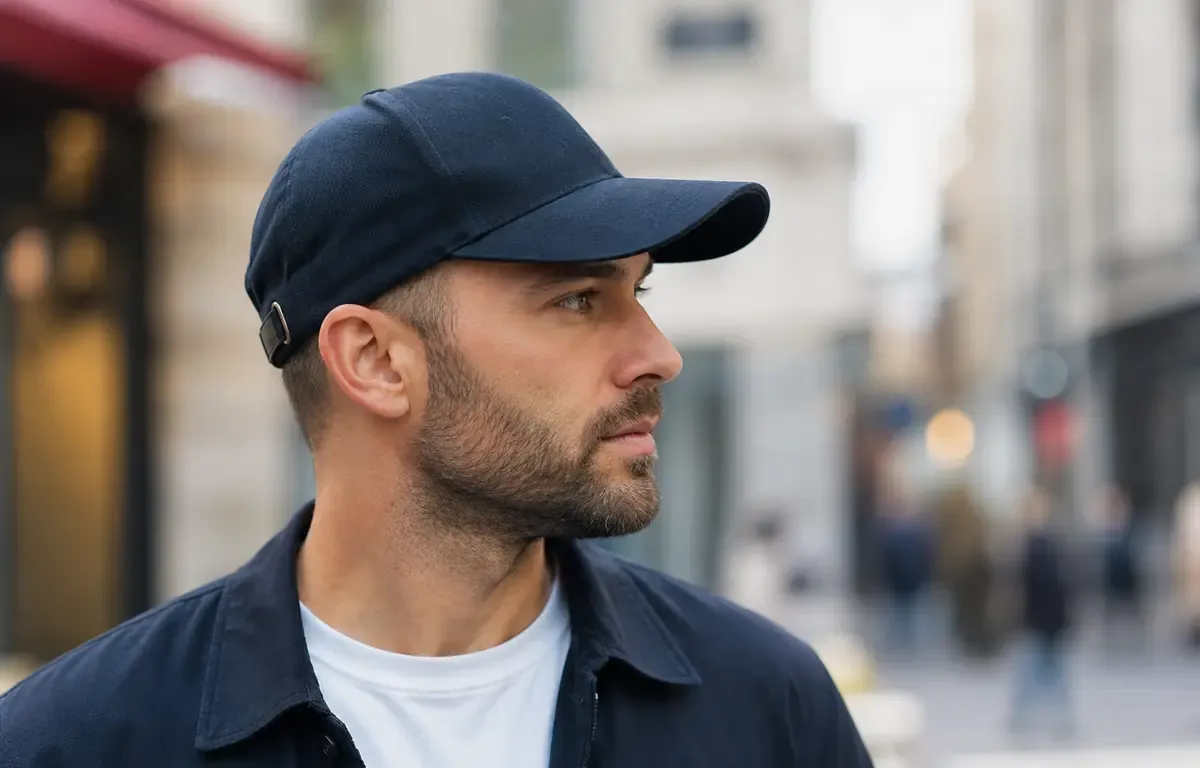
Karim was 29, a scooter delivery rider, and he wore the same black cap all day long — first out of habit, then to hide temples that were thinning. The day he walked into my office, his first sentence wasn’t a question. It was a confession: “I think it’s my fault. I’m suffocating my hair with this cap.”
He was almost relieved to have a culprit. Something he controlled. Something he could stop.
I stopped him right there. His cap had never made a single hair fall out. And by pinning the blame on it, he’d talked himself out of the one smart thing left to do: look the real cause in the eye.
If you’re reading this, you’re probably like Karim. You wear a hat to mask early thinning, and you’re scared you’re making it worse. Good news: 95% of the time, you’re worrying for nothing. Bad news: while you feel guilty, the actual problem keeps advancing. We’ll fix both.
Where this stubborn myth comes from
The “hats make you bald” myth is one of the stickiest in all of guy culture. We pass it around between friends, in locker rooms, at family dinners. “Take your cap off, you’ll lose your hair.” How many times have you heard it?
It rests on three intuitions that feel logical — and are all wrong.
The first: “hair needs to breathe.” It’s the most common idea, and the most biologically absurd. The hair shaft — the visible part — is a dead fiber made of keratin. It doesn’t breathe, any more than your nails do. As for the root, it’s buried in the dermis and fed by blood vessels. It gets its oxygen from blood, never from the air circulating above your scalp.
The second: “hats trap heat and sweat.” Heat, discomfort — so we imagine damage. But sweat doesn’t kill a follicle. As we’ll see, it can create discomfort, not baldness.
The third is subtler: observed correlation. Many men who are losing hair start wearing a cap precisely to hide it. The outside observer sees “cap + baldness” and reverses cause and effect. The hat didn’t create the baldness. The baldness created the hat.
💡 Thomas R.’s take: “I spent years on clinical shoots in Turkey, cap glued to my head eight hours a day because of the sun. My hair didn’t move a millimeter — because I don’t have a strong genetic predisposition. Next to me, colleagues who never wore anything were thinning visibly. The cap has absolutely nothing to do with it. Genetics decides, full stop.”
What the science actually says
Let’s be clear, because this is the question eating at you: no, wearing a hat does not cause androgenetic alopecia — common baldness, the kind that thins the temples and crown.
Male pattern baldness is a matter of hormones and genes. It’s driven by DHT (dihydrotestosterone), a testosterone derivative that binds to receptors in genetically sensitive follicles. DHT gradually miniaturizes those follicles until they produce only fuzz, then nothing. This happens deep in the dermis. No hat, however tight, can influence a hormonal reaction taking place several millimeters under the skin.
The most telling evidence comes from identical twin studies. Identical twins share the same DNA. When one wears a cap every day and the other never does, their hair evolution stays identical. That’s the cleanest proof the hat isn’t a factor. What matters is the genetic code — and twins share it.
And the “lack of oxygen” argument? It collapses instantly. If ambient air fed the follicles, no hair transplant would work: a graft is implanted deep, supplied by blood. Surgeons don’t install “air vents” on the scalp. The follicle is a vascularized organ, not a potted plant.
Let’s run through the beliefs one by one — which is exactly what the interactive myth meter just below does.
The only real risk: friction and hygiene
Now, let’s be honest: saying “a hat has no effect” would be a lie. It has no effect on genetic baldness. But in specific cases it can create two very real problems — neither of which is baldness, and both easy to fix.
Problem #1 — Folliculitis and irritation. A cap worn all day, never washed, turns your scalp into a hot, humid environment. Sebum, sweat and bacteria build up. The possible result: itching, greasy dandruff, small spots along the forehead. That’s mechanical folliculitis, not alopecia. But if it settles in, the chronic inflammation it feeds doesn’t help a scalp already weakened by DHT. It’s an indirect aggravating factor, not a cause.
💡 Thomas R.’s take: “The number of patients who show me ‘bald patches’ that are actually irritative folliculitis under the cap is staggering. We clean the scalp, space out the wear, sanitize with a tea tree shampoo, and three weeks later the redness is gone and the hairline hairs grow back. They were never ‘dead’ hairs. Just hairs living in a hostile environment.”
Problem #2 — Traction alopecia. This is the only scenario where a hat can genuinely make hair fall out — and it’s rare. If you constantly wear a very tight cap that leaves a red mark on your forehead, the repeated mechanical tension on the front edge can, over months or years, weaken the follicles along the hairline. It’s the same mechanism as overly tight hairstyles: traction alopecia, localized at the temples and hairline, with zero connection to crown baldness.
The good news: caught early, traction alopecia is reversible. You just release the tension.
Hold onto the key nuance: a hat never creates androgenetic alopecia. At worst, worn badly, it sustains irritation or mild friction along the edge. Two minor problems, two simple solutions.
Test: is your hat a risk?
Enough theory. Let’s look at your actual case. The module below does two things: it dismantles the beliefs one by one (tap the cards for the verdict), then it calculates your real risk level based on how you wear your hat.
The Hat Myth Meter
4 beliefs everyone repeats. Tap a card to reveal the verdict.
Is your hat actually a risk?
4 questions, 30 seconds. We calculate your real risk — and reassure you (or not).
If the test puts you at “zero risk,” stop feeling guilty right now. If you land in orange or red, it’s still not baldness — but a few hygiene tweaks will do you good. We detail them below.
The real culprit behind your hair loss
Here’s the part nobody wants to hear, but it changes everything: if your hair is genuinely falling — temples receding, crown thinning, hairline climbing — it’s not the hat. It’s DHT.
As long as you blame your headwear, you aren’t treating the real cause. And time works against you. Androgenetic alopecia is progressive: every month without action is a month of slightly more miniaturized follicles.
So the first thing to do isn’t to take off your hat. It’s to get a diagnosis. Is this real, established baldness, or a temporary shed? Our guide to the first signs of balding in men gives you the pull test and the miniaturization criteria to decide. And if you’re in your thirties, the article male hair loss at 30: normal or warning details the role of stress and lifestyle.
Once the diagnosis is in, the real weapons are well known and documented:
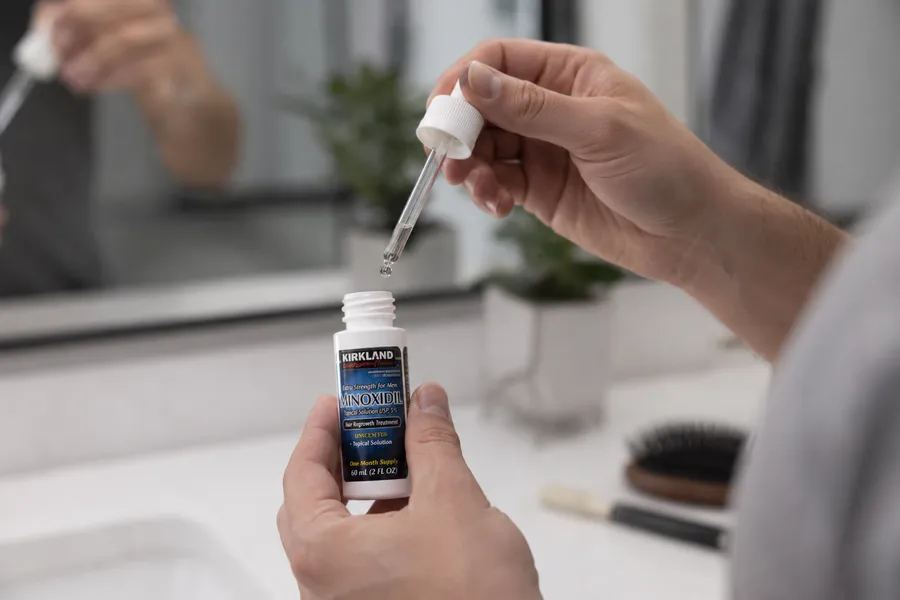
- Topical minoxidil, which extends the hair’s growth phase — the full protocol is in our minoxidil 5% for men guide;
- Local DHT blockers, like rosemary oil, covered in our complete Mielle rosemary oil review;
- Ketoconazole shampoo, which reduces follicle exposure to DHT at the scalp — we cover it in a dedicated guide, the best ketoconazole shampoo for baldness.
That’s where the fight is. Not under your cap. For the full picture of causes and solutions, keep our complete men’s hair loss guide handy.
💡 Thomas R.’s take: “I say it every consultation: the worst mistake isn’t wearing a cap. It’s believing that taking it off solves the problem. I’ve seen men ‘quit the cap’ for two years, proud of themselves, and show up Norwood 4 because they did nothing else. Keep your cap if you want. But attack DHT in parallel.”
Wear your hat without guilt: the hygiene protocol
You can keep your hat. Really. You just need a few hygiene rules to avoid folliculitis and give your scalp a healthy environment. Here’s the routine I give my patients.
1. Wash your hat. Sounds obvious, yet. A cap worn daily should be washed every one to two weeks. It’s the thing concentrating sebum and bacteria. A clean cap is 50% of the problem solved.
2. Sanitize the scalp twice a week. A tea tree purifying shampoo is the perfect tool: tea tree essential oil is antibacterial and antifungal, it regulates sebum and calms itching. It’s the move that erases that “suffocating head” feeling.
Tea Tree Purifying Shampoo
Deep-cleans the scalp under the cap · Antibacterial and antifungal tea tree · Regulates sebum and soothes itching · No occlusive silicones
- Clears sebum and buildup
- Calms hairline irritation
- Lasting fresh feeling
- Twice a week is enough
$13.90
View on AmazonAffiliate link
3. Let the scalp recover in the evening. When you get home, take the hat off and give your scalp 3 minutes. A silicone scalp massage brush lifts buildup, gently exfoliates and, above all, stimulates microcirculation at the bulb — regular massage is one of the few mechanical moves with documented benefit on vascularization. It’s the “decompression” moment of the day.
Silicone Scalp Massage Brush
Soft silicone bristles for the evening massage · Gently exfoliates and lifts sebum from under the cap · Stimulates microcirculation at the bulb · Wet or dry use
- Stimulating 3-min nightly massage
- Exfoliates without harshness
- Improves absorption of treatments
- Hygienic and easy to rinse
$9.90
View on AmazonAffiliate link
4. Loosen it a notch. If your cap leaves a mark, set it looser or change models. You instantly remove the only real mechanical risk.
5. And meanwhile, treat the cause. If real hair loss is underway, add a local DHT blocker in the evening. Rosemary oil is the simplest first move — pre-diluted, no rebound effect, massaged in 3 times a week.
Mielle Organics · Rosemary Mint Scalp Oil
Local DHT blocker for the evening · Rosmarinic acid + vasodilating menthol · The natural first move while you sanitize the scalp · No prescription
- Targets the real cause (DHT)
- Vasodilating menthol
- Pairs with the evening massage
- Panahi 2015 study
$11.90
View on AmazonAffiliate link
Five moves. None of them is throwing out your hat. All of them separate what’s hygiene (your headwear) from what’s treatment (DHT).
Frequently asked questions
Does wearing a hat every day really make your hair fall out?
No. Daily hat wear does not cause androgenetic alopecia. The only risk, with a very tight cap worn constantly, is mild traction alopecia along the edge — rare and reversible. Common baldness is hormonal and genetic: it develops whether you wear a hat or not.
Can sweat under the hat speed up hair loss?
Sweat itself doesn’t kill follicles. But a hot, oily, never-cleaned scalp can develop folliculitis or itching, which sustain local inflammation. That’s not baldness, but it weakens the terrain. A purifying shampoo twice a week and a regularly washed cap solve it.
If I stop wearing a hat, will my hair grow back?
If your loss is genetic (DHT), no: removing the hat changes nothing, because it wasn’t the cause. If you had irritative folliculitis or mild traction, then yes, sanitizing and releasing tension can let the hairline hairs recover. Hence the importance of getting the right diagnosis before concluding.
Which type of hat is least risky?
A breathable-material cap (cotton, linen), loosely fitted — one that leaves no mark on your forehead — and washed regularly. Avoid overly tight models worn for hours without a break. Comfort is your best indicator: if it squeezes, loosen it.
Is a beanie the same as a cap?
Same logic. A beanie doesn’t cause baldness. Since it’s usually warmer and covers the whole head, it promotes more sweating and therefore irritation if hygiene is neglected. Same rules: wash, sanitize, air out in the evening.
My temples are receding. Is it the hat or genetics?
Symmetrically receding temples are the signature of androgenetic alopecia, not a hat. Do the pull test and watch for miniaturization: our guide to the first signs of balding helps you confirm. And above all, act on DHT rather than on your wardrobe.
Sources and references
-
Sinclair R. — Male pattern androgenetic alopecia — BMJ, 1998. PubMed
-
Nyholt DR. et al. — Genetic basis of male pattern baldness (twin and heritability studies) — Journal of Investigative Dermatology, 2003. PubMed
-
Pulickal JK., Kaliyadan F. — Traction Alopecia — StatPearls, 2023. NCBI
-
Panahi Y. et al. — Rosemary oil vs minoxidil 2% for androgenetic alopecia: a randomized comparative trial — Skinmed, 2015. PubMed
-
Piérard-Franchimont C. et al. — Ketoconazole shampoo: effect of long-term use in androgenic alopecia — Dermatology, 1998. PubMed
Scientifically validated by our committee of trichology experts.