
Medically reviewed by our internal panel of dermatology experts.
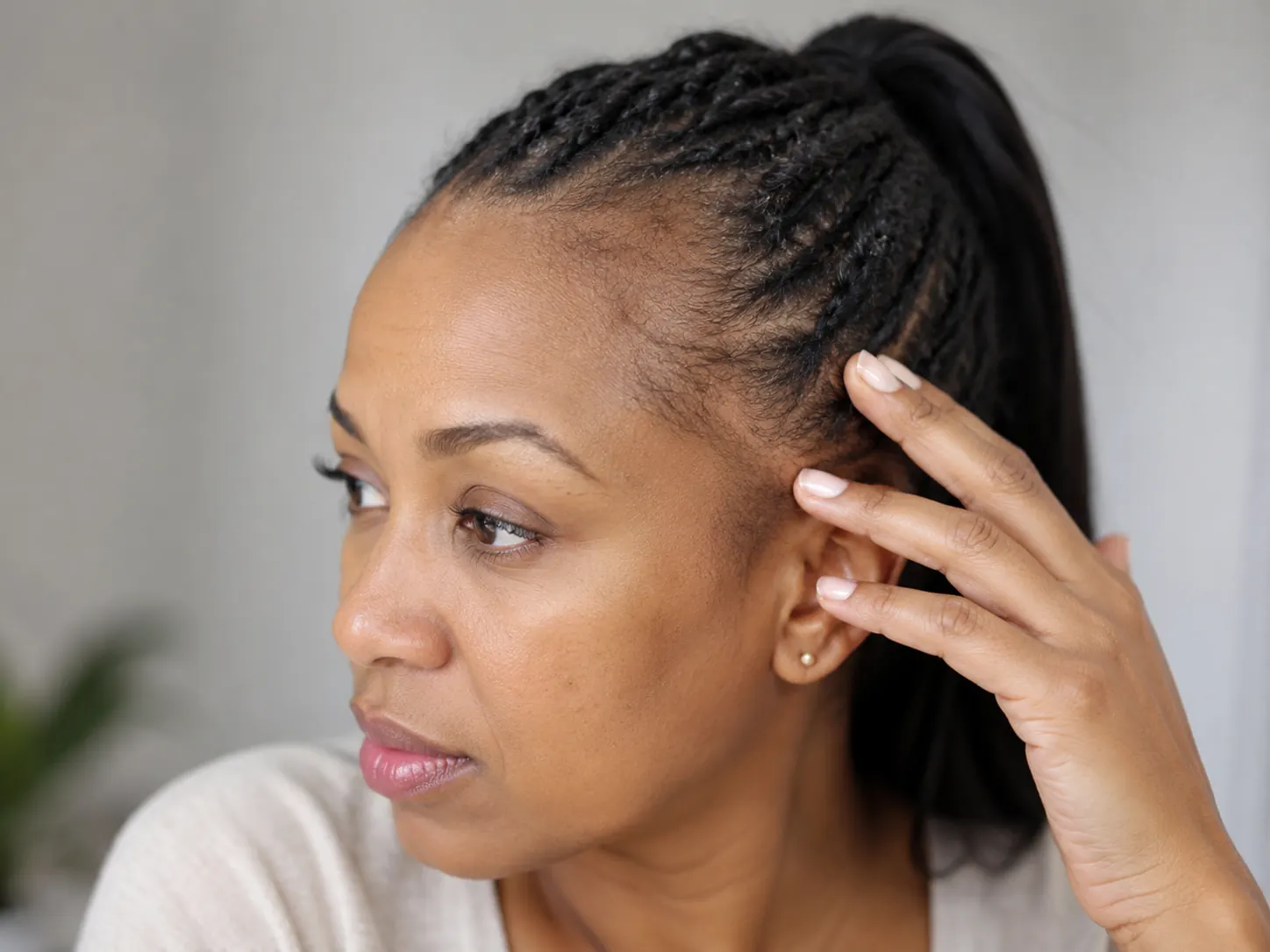
Aïcha was 31. She walked into my office one February morning with her scarf pulled low across her forehead. She kept it on for the first ten minutes of the consultation. When she finally took it off, I understood why.
Her hairline had receded about three centimeters. Both temples were completely bare. Not a single hair. Skin that looked shiny, slightly stretched. And behind that bare zone, a dense and beautiful head of hair.
“My braids have always been tight like this,” she told me. “My mother styled me the same way as a child. I never imagined it could do this.”
I’ve had this consultation dozens of times in nine years. With Afro-descended women for whom tight braids are cultural. With white women who’ve worn a high bun every day since adolescence. With women whose hijab elastic always presses on the same spot. And increasingly, with women who’ve kept heavy extensions in for three uninterrupted years.
The diagnosis is almost always the same: traction alopecia. And the question that follows, asked in a low voice, is always the same too: “Will it grow back?”
The honest answer is: yes, but on one critical condition — act before fibrosis sets in. This guide explains how to find your stage, which protocol to start this week, and exactly when natural regrowth is no longer possible.
Recognize traction alopecia: the signature that never lies
Many women come in thinking they have early androgenetic alopecia, a deficiency or stress shedding. But traction alopecia has a unique anatomical signature that no other condition shares — and recognizing that signature changes everything, because it implies a completely different treatment.
The geographical pattern: edges and hairline first
Traction alopecia never affects the crown first. It’s the first thing I check in consultation. The damaged zone always follows the exact lines of tension:
- Symmetrically receding hairline, in a half-circle, over 1 to 4 cm
- Totally bare edges or hairs so ultra-fine they’re almost transparent
- Hairline behind the ears if you wear braids pulled back
- Vertex thinning only with daily high buns for over five years
If your loss affects the crown first without affecting the hairline, it’s not traction alopecia — it’s probably female pattern hair loss that demands a totally different protocol.
The “fringe sign”: the marker that confirms it 95% of the time
This is a clinical detail few patients know about, yet it makes the diagnosis in five seconds. On a true traction alopecia, we almost always observe a thin line of preserved hairs right at the front, 2 or 3 millimeters from the hairline — as if those hairs had been protected. This is what Anglo-Saxon dermatologists call the “fringe sign”.
Those few hairs survived because they were too short or too fine to be caught by the braid, elastic or extension. The fringe sign appears in about 95% of confirmed traction alopecias (Goldberg, 2009) and helps distinguish this pathology from frontal fibrosing alopecia, which destroys that fringe.
Warning symptoms that announce the next bare zone
Traction doesn’t destroy a follicle overnight. It exhausts it over months, sometimes years, before the area becomes completely smooth. If you have these signs, you’re still in the action window:
- Tight, painful scalp sensation after styling
- Small red pustules (traction folliculitis) on the hairline
- Hairs that systematically stay in the elastic
- Progressive thinning visible on before/after photos over years
- Localized headaches over the tension zone
💡 Elena S.’s take: “A patient told me one day: ‘But it doesn’t hurt when I get braided, so it’s not tight.’ I replied: that’s exactly the problem. The hair follicle has no direct pain receptor — it’s the skin that suffers, not the bulb. By the time pain sets in, inflammation is already deep. The bulb itself takes the punishment in silence for years before dying. Never use absence of pain as proof of safety.”
Assess your clinical stage in 4 questions
Before choosing a protocol, pin down your stage precisely. Reversible traction, established traction and fibrotic traction call for radically different strategies — and above all, completely different regrowth timelines.
Visual assessment · 4 questions
Can your edges still regrow?
Question 1 / 4
How long has your hairline been receding?
💡 Staging scale adapted by Elena S. from the clinical classification of traction alopecia (Khumalo & James, 2007).
Whatever your stage, remember the golden rule: traction alopecia regrowth is entirely conditional on the total and immediate cessation of the mechanical cause. No serum, no oil, no transplant will work as long as traction continues. It’s mathematical.
The edge regrowth protocol: 4 actives in synergy
On a stage I or II traction alopecia, I’ve seen genuinely striking results following a precise 6 to 12 month protocol. Not a miracle serum — four actives with complementary mechanisms, applied on a rigorous schedule.
Step 1: Jamaican Black Castor Oil (JBCO)
This is the flagship and historic active for edge regrowth — used for generations in the Caribbean and West Africa for exactly this indication. JBCO (Jamaican Black Castor Oil) differs from classic castor oil by its production process: seeds are roasted before pressing, which produces alkaline ash (hence the black color) and increases available ricinoleic acid content.
Ricinoleic acid has two documented actions on the traumatized follicle: it reduces local inflammation via the EP3 pathway (Vieira et al., 2000) and improves peri-follicular microcirculation through a vasodilatory effect. On an area destroyed by traction, these two mechanisms are precisely what the miniaturized follicle needs to restart a complete hair cycle.
Jamaican Black Castor Oil · 100% Pure
Cold-pressed after roasting · Rich in ricinoleic acid · Apply 4 evenings per week on temples and hairline · Massage for at least 60 seconds
- Authentic roasted JBCO
- Local anti-inflammatory
- Scalp vasodilation
- Reduces peripheral breakage
$16
View on AmazonAffiliate link
The usage detail that changes everything: apply on dry scalp, never on wet hair. JBCO is thick — many women use too much. A pea-sized amount for both temples is enough. Massage with fingertips in slow circular movements for at least 60 seconds per side. Leave on overnight, wash in the morning with a gentle shampoo. Four evenings a week — not more, to avoid saturating the follicular ostium.
Step 2: Rosemary essential oil
This is the complementary active that works on a totally different mechanism: partial inhibition of local 5α-reductase. The Panahi et al. (2015) study, published in SKINmed, compared cineole-rich rosemary oil to 2% minoxidil on 100 androgenetic alopecia patients, with equivalent results at 6 months. On traction alopecia, its role is slightly different: it soothes chronic peri-follicular inflammation and stimulates microcirculation, working synergistically with JBCO.
For women who prefer a ready-to-use, pre-diluted and well-known formula, the American best-seller Mielle Organics Rosemary Mint Scalp Oil has popularized this approach across the Afro-descended community. I’ve published a complete review of Mielle Rosemary Oil detailing its exact composition, its real efficacy on edges, and how to combine it with JBCO without saturating the scalp.
Mielle Organics · Rosemary Mint Scalp Oil
Ready-to-use oil based on rosemary essential oil · Synergistic with biotin, jojoba and peppermint · Apply 2 to 3 times per week alternating with JBCO · Global best-seller
- Rosemary already properly diluted
- Safe for daily use
- Documented anti-DHT effect
- Suitable for all textures
$13
View on AmazonAffiliate link
Step 3: The round-tip massage brush — the underrated tool
This is the accessory nobody mentions in routines and yet plays a key role in edge regrowth: gentle mechanical scalp massage. A Japanese study (Koyama et al., 2016, Eplasty) showed that 4 minutes of daily manual massage over 24 weeks significantly increased follicular thickness in men with early-stage alopecia. The mechanism: mechanical stretching of dermal papilla cells, which activates the growth factor pathway.
A round-tip massage brush (never pointed tips, which scratch and create micro-trauma) applied to the edges for 3 minutes morning and evening is exactly that repeated mechanical stimulus — without the aggressive motion of classic brushing. And unlike a dermaroller, it creates no lesions: it pushes the skin, it doesn’t pierce it.
Scalp Massage Brush · Round Wooden Bristles
Non-aggressive round bristles in wood or soft silicone · 3 minutes morning and evening on edges and hairline · Use on dry scalp or with a few drops of oil
- No micro-trauma
- Dermal papilla stimulation
- Compatible with JBCO
- Usable even with tenderness
$12
View on AmazonAffiliate link
💡 Elena S.’s take: “Naomi, a 26-year-old musician, came back at 4 months into the protocol with a photo of her left temple. We could see fine, light-colored fuzz on a still-visible skin background. She asked me: ‘Is that just facial fuzz growing, or are these really hairs coming back?’ I explained that this is exactly how regrowth begins — through translucent vellus hairs that won’t become visible pigmented hair until month 8 or 9. Most women stop their protocol precisely at this stage thinking it’s not working. If you see fuzz, you’re on the trajectory — don’t quit.”
Step 4: The silk bonnet for the night
This is the detail that amplifies all the other efforts. At night, your head rubs 6 to 8 hours against ordinary cotton. On edges in regrowth, this repeated friction methodically destroys the fragile vellus hairs that are precisely trying to grow back. A natural silk bonnet (mulberry, 22 momme minimum) creates a smooth surface that eliminates these mechanical micro-traumas.
For women who can’t sleep in a bonnet, a silk pillowcase is a decent alternative — less effective on the hairline because the head moves during sleep.
Natural Mulberry Silk Sleep Bonnet
22 momme natural silk · Soft adjustable elastic · Wear every night without exception · Indispensable throughout the regrowth phase
- Protects vellus hair from breakage
- Preserves hydration
- All hair textures
- Machine washable in mesh bag
$18
View on AmazonAffiliate link
Multi-peptide serum: add at stage II
If your assessment placed you in stage II (established miniaturization), the base protocol is no longer enough. You need to add a multi-peptide serum with GHK-Cu that works on peri-follicular collagen regeneration and dermal vascularization — exactly the two structures that prolonged traction has damaged in depth. This serum isn’t a miracle product, it’s a background activator added on top of the previous four steps.
Multi-Peptide Hair Density Serum · GHK-Cu
GHK-Cu + Capixyl + REDENSYL + caffeine · Morning application on traction zones · Compatible with JBCO applied in evening · Effect over 4 to 6 months minimum
- Bioactive peptides
- Collagen regeneration
- Dermal vascularization
- Compatible with sensitive scalp
$36
View on AmazonAffiliate link
Hairstyles to stop immediately (and the ones still safe)
No topical protocol will work as long as traction continues. It’s non-negotiable. Here’s the precise list of at-risk hairstyles I work through with each of my patients in consultation.
Hairstyles to stop completely
- Very tight braids (box braids, cornrows with tight roots, glued African braids)
- Daily high buns (the tightly pulled “ballerina bun”)
- Sewn or glued extensions on the hairline — the leading cause of underdiagnosed massive traction alopecia in white women
- Ponytails pulled tightly upward worn more than 6 hours a day
- Weaves with tight base braids (the weight of the weft multiplies traction)
- Tight night rollers like curlers fixed at the root
Acceptable protective hairstyles
- Loose braids where you can slide a finger between the braid and scalp
- Low buns without a tight elastic (use silk scrunchies)
- Hair worn down or half-attached
- Well-maintained locs/dreads without root tension (consult a specialized loctician)
- Headscarf tied loose with no tension on the hairline
💡 Elena S.’s take: “A patient told me recently: ‘So I have to go to work with my hair down every day for a year?’ I answered honestly: for at least 6 months, yes. Your edges are in convalescence — exactly like a broken ankle. You wouldn’t walk on it until it’s consolidated. For your hair, it’s the same. The acute recovery phase demands suspending all hairstyles that apply tension to the hairline, without exception, for the duration needed for vellus hair regrowth. Six months minimum. A year if you’re in stage II.”
The silk scarf test
A simple home test: take a silk scarf, place it on your head without tying, and watch your usual hairstyle in a mirror. If you see your temple skin stretch at the first tightening, you’re past the threshold. Any hairstyle that creates folds in your scalp skin damages follicles long-term, whatever your hair culture of origin.
When FUE transplant becomes the option: recognizing fibrosis
Let’s be honest: there is a point of no return. When traction has lasted more than 8 to 10 years and the area has been completely smooth for over 3 years, the follicles are no longer in miniaturization — they’re in cicatricial fibrosis. The dermal papilla has been replaced by connective tissue. At this stage, no topical can do anything, because there’s no follicular stem cell left to activate.
Clinical signs of fibrosis
- Totally smooth, shiny skin, slightly depressed compared to the rest of the scalp
- Total absence of vellus hairs even after 8 months of strict protocol
- Trichoscopy showing absence of follicular ostia (scalp pores have disappeared)
- No response to 2% minoxidil at 6 months
- History of dissecting folliculitis or recurrent pustules over the area
At this stage, the only restoration possible is a targeted FUE (Follicular Unit Extraction) hair transplant on the hairline and edges. The technique consists of harvesting follicles from the donor zone (occiput) and implanting them one by one in the fibrotic area. The take rate is slightly lower than on healthy scalp (75–85% vs 90–95%) because local vascularization is impoverished, but the result remains very satisfying with experienced surgeons.
I systematically direct my fibrotic patients to our complete guide on the best hair transplant clinics in Spain, where the DHI (Direct Hair Implantation) technique delivers excellent results on hairlines. For tighter budgets, the Turkey 3000 grafts hair transplant cost comparison remains a serious option provided you pick a reputable clinic.
The critical window: act before 5 years
This is the data I hammer home with my younger patients: the longer the traction, the less natural regrowth is possible. The Khumalo and James literature review (Br J Dermatol, 2007) establishes a direct correlation between traction duration and follicular fibrosis rate:
- < 2 years of traction: 85% of follicles preserved, full regrowth possible
- 2 to 5 years of traction: 50 to 70% follicles preserved, partial regrowth
- 5 to 10 years of traction: 20 to 40% preserved, fibrosis established on over half
- > 10 years of traction: less than 20% preserved, massive fibrosis, transplant only option
The good news: if you’re reading this guide within the < 2 years window, you’re at the best possible moment to act. Every month counts. My patients who started the protocol within the first 18 months of their traction almost all recovered a satisfying hairline in 12 to 14 months — without resorting to transplant.
FAQ — Your common questions on edge regrowth
How long before I see the first results on my edges?
A follicle restarting its cycle takes between 12 and 16 weeks to produce a visible vellus hair, then 4 to 6 additional months for it to reach a normal pigmented caliber. Concretely: translucent vellus hairs at month 3-4, fine pigmented hairs at month 7-8, satisfying density at month 10-14. Any woman who tells me she stopped her protocol “after 6 weeks because it wasn’t working” simply proves she underestimated the biological mechanics. Follicular biology is slow — you can’t accelerate anything.
Should I apply JBCO every day?
No, and this is the most common mistake. Four evenings per week maximum. JBCO is occlusive and thick — applied daily, it ends up saturating the follicular ostium and mechanically blocking the exit of the new growing hair. The ideal rhythm: Monday, Wednesday, Friday, Sunday (for example), with a gentle shampoo the next morning. On other days, you can apply the multi-peptide serum (aqueous texture) or do a dry massage with the round-bristle brush.
Does 2% minoxidil help on traction alopecia?
Yes, but only as a second-line option after 4 months of strict topical protocol, and only on dermatological prescription. Topical 2% minoxidil has a proven effect on vascularization and anagen phase extension, which can help boost vellus hair regrowth in stage II. But it has a crucial limit on traction: it can’t do anything if the mechanical cause hasn’t been removed, and it has the same constraint as on hormonal alopecia — stopping it returns hair to its previous state. For women transitioning to menopause who combine traction with hormonal loss, also read our guide on menopause hair loss treatment.
My braids are cultural and identity-defining — do I really have to stop everything?
This is the hardest question, and I take it very seriously. No, you don’t have to give up your hair identity. You have to transform your technique. I systematically work with my Afro-descended patients to identify a loctician or Afro stylist specialized in fragilized hair (often trained in “low-tension techniques”). Braids can be done without root tension, starting 1 cm behind the hairline (“no edges” technique), with lighter sections, and kept in for a maximum of 4 weeks. It’s radically less aggressive without giving up the style. The compromise is culturally viable for most of my patients.
What if I’m postpartum on top of having traction alopecia?
This is a frequent and particularly frustrating case: two different mechanisms compounding on the same zone. Postpartum shedding is hormonal and diffuse, traction is mechanical and localized. The protocol must treat both: stopping traction + JBCO + rosemary for the temporal zone, plus the complete nutritional postpartum protocol (ferritin, B12, omega 3s) internally. If you’re in this case, read our complete guide on postpartum hair loss alongside this one.
Sources and Clinical Studies
-
Khumalo NP, Jessop S, Gumedze F, Ehrlich R. — Hairdressing is associated with scalp disease in African schoolchildren, Br J Dermatol, 2007; 157(1): 106–110. PubMed
-
Goldberg LJ. — Cicatricial marginal alopecia: is it all traction?, Br J Dermatol, 2009; 160(1): 62–68. PubMed
-
Panahi Y, Taghizadeh M, Marzony ET, Sahebkar A. — Rosemary oil vs minoxidil 2% for the treatment of androgenetic alopecia: a randomized comparative trial, SKINmed, 2015; 13(1): 15–21. PubMed
-
Koyama T, Kobayashi K, Hama T, et al. — Standardized scalp massage results in increased hair thickness by inducing stretching forces to dermal papilla cells, Eplasty, 2016; 16: e8. PubMed
Medically reviewed by our internal panel of dermatology experts. This article is informational and does not replace medical consultation. If in doubt, consult a dermatologist specialized in female alopecia or a trichologist.