Medically reviewed by our internal trichology expert board.
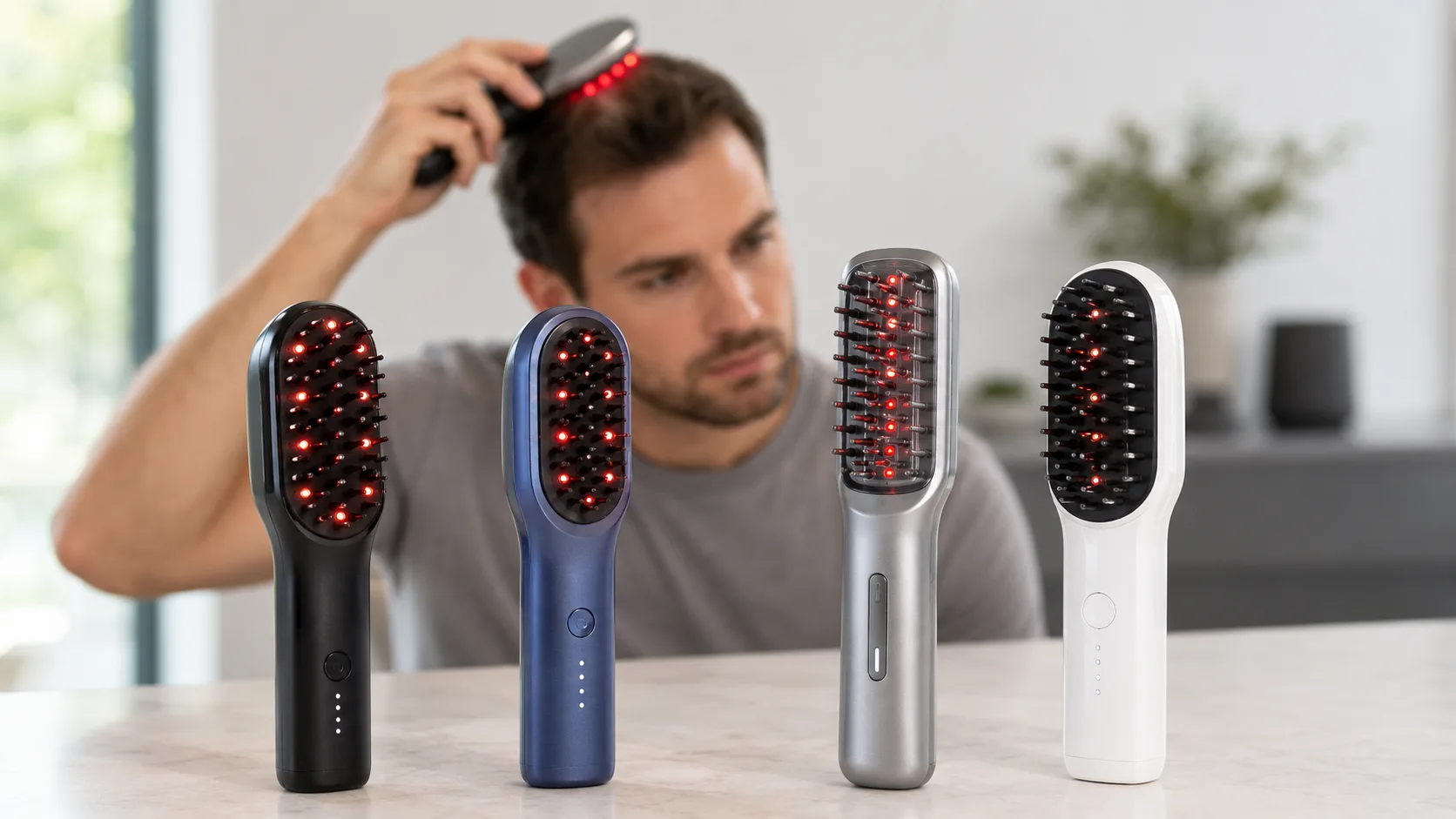
It looks like a comb. It has roughly the same weight, the same shape, and honestly the same generic appearance. Except at the tip of each tooth, there are laser diodes at 650 nanometres emitting a red light you can barely see.
The first time I held a HairMax in my hands was at a tech expo in Barcelona in 2023. The rep handed it to me with the confidence of someone who already expects scepticism. “Dozens of clinical studies,” he said. “FDA clearance since 2007.”
I checked. He was right on both counts.
That didn’t mean I pulled out my wallet that day. It took three months of PubMed reading, two systematic reviews, and a home protocol test before I committed. Conclusion: the laser hair growth comb is one of the most clinically documented affordable tools in the anti-hair-loss space. And one of the most misused — because almost nobody explains what actually happens at the cellular level, let alone the exact protocol that separates “it works” from “I wasted $200.”
This is the review I wish I’d found first. Not a product list. An analysis. Mechanism, evidence, real limits — and an honest comparison of the models actually worth buying in 2026.
How LLLT photobiomodulation actually works
LLLT. Low Level Laser Therapy. Sometimes called photobiomodulation. The concept: expose tissue to coherent low-power light at a specific wavelength to trigger biological effects — without heat, without tissue damage. A surgical laser cuts and burns. An LLLT laser delivers photonic energy cold. These are not variations on a theme. They are fundamentally different technologies.
What happens at the cellular level is more interesting than the acronym.
Cytochrome c oxidase absorption: the key mechanism
In every cell, mitochondria produce cellular energy as ATP through the respiratory chain. The key enzyme in this chain, at Complex IV, is called cytochrome c oxidase (COX). This enzyme specifically absorbs photons in the red and near-infrared wavelengths — particularly around 630–670 nm.
When laser photons are absorbed by COX, they accelerate electron transfer through the respiratory chain. Result: increased ATP production, reduced cellular oxidative stress, and activation of signalling pathways linked to cell proliferation and survival.
In hair follicles, this energy activation translates directly into:
- Prolonged anagen phase — follicles stay in active growth longer
- Stimulated keratinocyte proliferation — the cells that build each hair shaft divide more actively
- Reduced perifolicular inflammation — often overlooked in androgenetic alopecia, this chronic inflammation accelerates miniaturisation
- Increased local blood flow — through indirect vasodilation, complementary to minoxidil’s mechanism but via a different pathway
This isn’t marketing copy. It’s published biochemistry.
The studies that hold up
Lanzafame et al. (2013) ran a double-blind randomised trial in 44 men with androgenetic alopecia. The active group used a helmet-style unit combining 21 laser diodes and 30 LEDs, all at 655 nm, every other day for 16 weeks. Hair counts rose 35% against the sham device — an identical-looking unit fitted with incandescent red bulbs.
Lanzafame et al. (2014) repeated the protocol in 47 women, same device, same 16 weeks. 37% this time, and the authors note the response tracked what they had measured in men.
Jimenez et al. (2014) is the trial that matters most for a comb specifically, because it tested one: the HairMax LaserComb, across several models, in a multicentre sham-controlled double-blind study. 128 men and 141 women, whole scalp, three sessions a week for 26 weeks. Terminal hair density rose significantly against sham, in both sexes, and — the detail worth keeping — efficacy held across the different laser configurations tested, as long as the dose rate delivered was comparable. Diode count is a matter of how long your session takes, not of whether it works.
FDA clearance: HairMax was the first LLLT device to receive FDA 510(k) clearance for hair loss treatment — for men in 2007, women in 2011. That doesn’t guarantee the product works for every case. It means the FDA validated the safety record and the evidence dossier submitted. No other segment of the consumer hair loss industry can say the same.
Thomas R.’s take: “What convinced me wasn’t the before-and-after photos online — it was the mechanism. Cytochrome c oxidase absorbs at 650 nm: that’s chemistry, not opinion. The question isn’t ‘can red light stimulate follicles?’ — the answer is yes, it’s documented. The real question is: ‘how do you optimise exposure for measurable results?’ And that’s where protocol makes everything."
"Infrared comb” or red comb: the word that means nothing on a listing
Search for one of these devices and half the results call themselves infrared. It is one of the most common ways people describe the product — and it is the description the shelf honours least.
Start with the physics, because it settles most of the question on its own. Human vision runs out somewhere around 700 nm. Past that you are in the infrared, and near-infrared light — the 800 nm region used in photobiomodulation research — is invisible. Not faint. Not deep red. Invisible.
So here is a test you can run without leaving the product page: look at the photos of the device switched on. If it glows red, that is visible red light. The listing may say infrared in the title, in the bullets and in the brand name; the photograph is showing you something else. In most cases the emitters are perfectly ordinary red ones at around 650 nm, and “infrared” was typed in because people search for it.
That is not a scandal, and it is worth being precise about why. Cytochrome c oxidase — the enzyme from the previous section — genuinely absorbs across both the red and the near-infrared. Near-infrared is a real photobiomodulation band, used in real research, and Hamblin’s mechanistic work covers both. The problem is narrower than “infrared is fake”:
- The trials behind these devices — Lanzafame twice, Jimenez on the comb itself — all sat at 655 nm, in the visible red. That is where the hair-loss evidence for home devices actually lives.
- Near-infrared has been studied for hair growth mostly alongside red, not instead of it, and in clinic-grade equipment rather than a handheld comb.
- A comb sold on the strength of the word “infrared”, with no wavelength printed anywhere, cannot be matched to any published protocol at all. There is nothing to check — in either direction.
One more thing worth separating, because the vocabulary invites the confusion: infrared is also what a heat lamp emits. LLLT is explicitly non-thermal — the whole point of “low level” is that the energy arrives cold. A scalp device that noticeably warms your skin is delivering heat, and heat is not the mechanism any of these studies measured. Pleasant, possibly. Not the same thing.
The practical conclusion is short. Ignore the word. Ask for the number.
Listing checker · 3 questions
Is that listing describing a device — or selling a word?
Open the comb you are looking at in another tab. Three questions, and you will know whether the seller specified a device or just typed "infrared" into the title.
Question 1 / 3
Does the listing give a wavelength — an actual number in nanometres?
💡 Checklist built by Thomas R. from the parameters actually used in the published clinical trials on LLLT for hair loss.
Laser comb vs high-frequency wand: two different technologies
When you search for “hair loss tech device” online, you find two categories that sellers love to conflate.
The laser comb (LLLT) uses laser diodes at a precise wavelength (630–670 nm). Mechanism: mitochondrial photobiomodulation. Clinical evidence: solid, published RCTs.
The high-frequency wand (Darsonval) works on an entirely different principle: a glass electrode filled with gas (neon or argon) produces a low-intensity high-frequency electrical discharge — the “corona” effect. It generates micro-quantities of ozone (antimicrobial), stimulates microcirculation through electrical stimulation, and can mildly warm the scalp.
High-frequency devices have been used in beauty salons since the 1920s. Useful for cleaning up an inflamed or seborrhoeic scalp, reducing excessive sebum, and stimulating circulation. Their clinical record for regrowth is significantly thinner than LLLT’s.
| Laser Comb (LLLT) | High-Frequency Wand | |
|---|---|---|
| Mechanism | Mitochondrial photobiomodulation | Corona electrical discharge |
| Wavelength | 630–670 nm (light) | 100–300 kHz (electricity) |
| Regrowth evidence | Published RCT studies | Primarily empirical |
| FDA clearance | Yes (HairMax) | No, for hair regrowth |
| Average price | $80–$350 | $30–$60 |
| Best for | Active follicle stimulation | Scalp cleansing, circulation |
Can they complement each other? Yes. High-frequency as scalp preparation (cleansing, microcirculation) before LLLT sessions is logical. But if you’re choosing one for regrowth, LLLT without question.
Darsonval High-Frequency Scalp Wand
Corona discharge to stimulate microcirculation and cleanse the scalp. A complement to the LLLT protocol — not a substitute. Best used as scalp prep 2–3×/week before laser sessions.
- Stimulates microcirculation
- Antimicrobial ozone effect
- LLLT protocol complement
~$38
See on AmazonAffiliate link
Laser comb vs LLLT helmet: which situation calls for which?
The right question isn’t “comb or helmet?” — it’s “for what situation?”
LLLT helmets (iRestore, Theradome, Capillus) cover the entire scalp simultaneously with 200 to 272 diodes. 25-minute hands-free sessions — you can watch a show while treating. Price: $500 to $3,000+.
The laser comb concentrates 7 to 82 diodes on a targeted zone. 10–15-minute sessions, device in hand, methodically covering zone by zone. Price: $80 to $350.
| Criterion | Laser Comb | LLLT Helmet |
|---|---|---|
| Price | $80–$350 | $500–$3,000+ |
| Coverage | Targeted zones | Full scalp |
| Portability | Excellent | None |
| Hands-free | No | Yes |
| Temples / hairline | ✓✓ Optimal | ✓ Possible |
| Crown | ✓ Good | ✓✓ Optimal |
| Travel | ✓ Yes | ✗ No |
| Early-stage AGA (NW I–III) | ✓✓ Suited | ✓✓ Suited |
| Advanced AGA (NW IV+) | ✓ Complementary | ✓✓ Preferred |
My conclusion after testing both formats: the comb is the right choice if your budget is under $300, you have targeted zones (temples, hairline, partial crown), and you travel regularly. The helmet is the right choice if you want total coverage without cognitive effort, AGA at stage IV or higher, and the budget available. The iRestore Essential — probably the most searched LLLT helmet in the English-speaking market — falls squarely in the helmet category. Our full treatments guide covers all options if you’re still deciding.
2026 comparison: the models worth your money
I’ve analysed and tested several devices in detail over 18 months. No paid rankings. Technical analysis only.
HairMax Ultima 12 LaserComb — the clinically documented reference
12 laser diodes, 650 nm, FDA clearance. This is the product with the most clinical data backing it among consumer-grade devices in this category.
The design is smarter than it looks. Comb teeth part the hair so the diodes reach the scalp directly. Most competitors fire diodes above the hair — meaning photons travel through the hair shaft before reaching the scalp, with significant attenuation. HairMax forces direct contact. This is not a minor design detail: a strand of hair absorbs and scatters a non-trivial proportion of photons before they reach the follicle bulb. Bypassing that barrier meaningfully increases the actual dose delivered.
Session: 11 minutes, 3 times per week. The device beeps to signal when to move to the next zone — an underappreciated feature that standardises the dose per area without counting in your head.
The HairMax range includes multiple models (Prima 9, Ultima 12, LaserBand 82). The key differentiator: number of diodes and therefore surface covered per pass. For temples and hairline, 12 diodes is more than sufficient. For simultaneous crown + temple coverage, the LaserBand 82 reduces session time to 3 minutes — at a higher price point.
HairMax LaserComb — Laser Hair Growth Brush
12 laser diodes at 650 nm with integrated comb-tooth system for direct scalp contact. FDA 510(k) clearance obtained in 2007. The reference laser hair growth comb with the most complete clinical record in consumer-grade devices.
- 12 laser diodes 650 nm
- FDA 510(k) clearance
- Direct scalp contact
- Zone-guidance beeps
~$200
See price on AmazonAffiliate link · Priority product
iRestore Essential vs HairMax: helmet vs comb
For the EN audience, iRestore comes up constantly in searches — and worth addressing directly.
The iRestore Essential is a helmet system (51 lasers + 30 LEDs, FDA-cleared), not a comb. It covers the full scalp in a 25-minute hands-free session. Price: around $700. It’s a strong product in its category. But the category is different: it’s a full helmet, not a portable targeted comb.
If your primary concern is temples and hairline — and your budget is under $300 — a HairMax comb gives you more targeted, portable, and affordable coverage than an iRestore helmet. If you want total scalp coverage with no technique required, iRestore is worth the investment. Two different tools for two different profiles.
Budget laser combs (Amazon, under $100)
They exist. Dozens of them, at $40–$80. Some have genuine 650 nm laser diodes. Others have red LEDs that mimic the look of a laser without the coherent light properties that make the clinical difference.
This is a real technical distinction: a laser produces coherent, monochromatic, collimated light — photons travel “in phase” and penetrate tissue differently from a diffuse source. The published clinical studies used lasers. LED-based phototherapy has its own studies, but they are different protocols with different outcomes.
My advice: verify that the listing explicitly states “laser diode 650 nm” — not “red light therapy,” not “LED,” not “laser effect.” If the manufacturer doesn’t specify the exact light source, it’s almost always an LED.
Portable Laser Hair Growth Comb — 650 nm
Portable LLLT laser comb for temples and targeted zones. Budget entry point before investing in a premium device. Verify 'laser diode 650nm' in the product listing — not 'red LED'.
- Portable and lightweight
- 650 nm LLLT
- Budget protocol entry point
Affiliate link
Which laser device fits your profile?
Four questions. One personalised recommendation based on your real profile.
Selector · 4 questions
Which laser device is right for you?
Question 1 / 4
Which area are you primarily targeting?
💡 Selector built by Thomas R. based on 12 years of hair restoration practice and published LLLT clinical data.
The right protocol: 4 rules that change everything
The laser comb is one of those tools where efficacy depends almost entirely on protocol. Follow it, or don’t bother.
Rule 1: minimum 3 sessions per week, no exceptions
Below 3 sessions per week, the cellular stimulation doesn’t accumulate enough to produce a measurable effect. Every study that shows positive results uses 3 to 5 weekly sessions. Not 2. Not “when I remember.”
I recommend 4 sessions during the loading phase (first 3 months), then 3 sessions for maintenance.
Rule 2: clean scalp, no product residue
Wet hair absorbs and scatters more light than necessary, reducing the actual dose reaching the scalp. Excess sebum can also create a barrier that attenuates photon absorption.
Clean doesn’t mean freshly washed — it means not greasy, no styling product residue. A scalp washed 6–8 hours before the session is ideal. No need to wash your hair just for the session: simply schedule it the morning after shampooing.
Rule 3: 1 cm per second, overlapping passes by 50%
This is the mistake I made for weeks. Moving the comb too fast, covering ground, feeling like the session is done. What counts: total photon dose per cm².
The correct pace: 1 centimetre per second, overlapping each pass by half to ensure no zone is under-dosed. Temples: 3–4 minutes per side. Crown: 5–6 minutes. Part line: 2–3 minutes.
Yes, that’s a long session. Put something on in the background. It’s doable.
Thomas R.’s take: “I spent two weeks doing it wrong. Sweeping the comb across my scalp in two minutes and calling it done. I re-read the studies, recalibrated the pace, set a phone timer per zone. The 6-month photos were noticeably different. Protocol matters as much as the device. Probably more.”
Rule 4: minimum 4 months before evaluating — photos are mandatory
The human follicle cycle lasts 3 to 6 months. It is biologically impossible to see meaningful results in under 12 to 16 weeks. Studies show first measurable densification at 16–24 weeks.
Don’t judge before 4 months. Take a reference photo on day 1, one every 6 weeks, in identical conditions (same light, same angle, dry hair). Photo comparison is the only reliable indicator — the mirror deceives you daily because you’re watching too slowly.
A practical travel bonus: if your device charges via USB-C, any power bank covers 3–4 sessions. One of the genuine advantages of a comb over a helmet.
Slim Travel Power Bank — USB-C
5,000 mAh slim power bank to continue your LLLT protocol while travelling. Universal USB-C compatibility — charges your HairMax or any rechargeable laser comb. Fits in a jacket pocket.
- Ultra-slim for carry-on
- Charges 3–4 laser sessions
- Fast USB-C charging
~$28
See on AmazonAffiliate link
Combining with other hair loss treatments
The laser comb is one of the few hair loss tools that is fully compatible with every other approach. No known negative interactions — just a few timing rules.
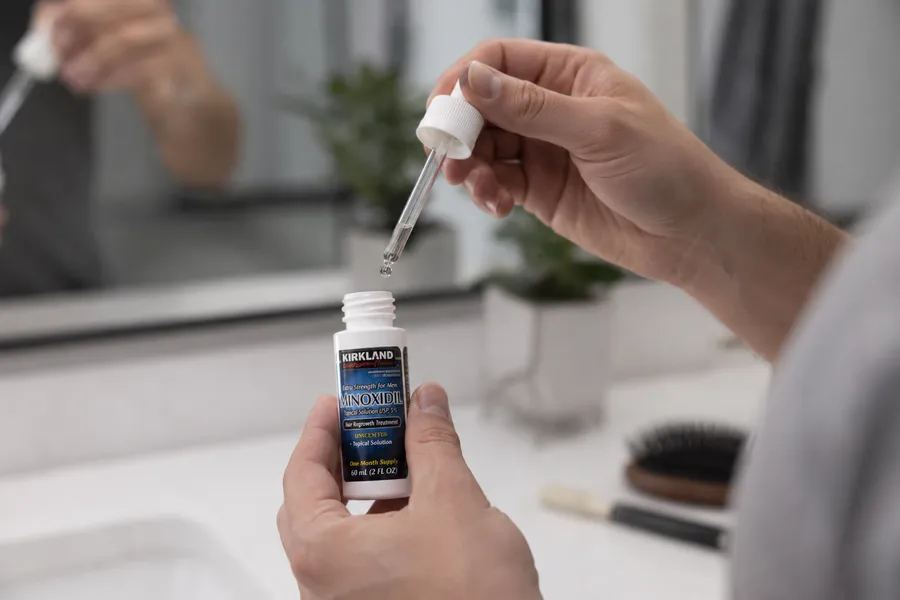
With minoxidil 5%: compatible. Keep a 1–2 hour gap — apply minoxidil at least an hour after a laser session so the slightly activated scalp doesn’t interfere with topical absorption. Some exploratory research suggests the combination improves results from both treatments versus either alone.
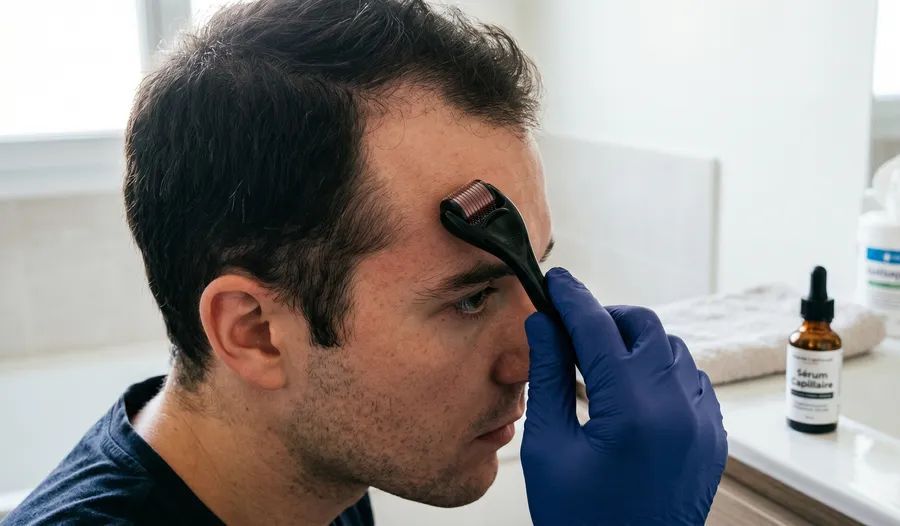
With the dermaroller: maintain 48 hours between a dermaroller session and a laser session. Microneedling creates superficial micro-injuries; laser light on healing skin can increase irritation. 48 hours is enough recovery time.
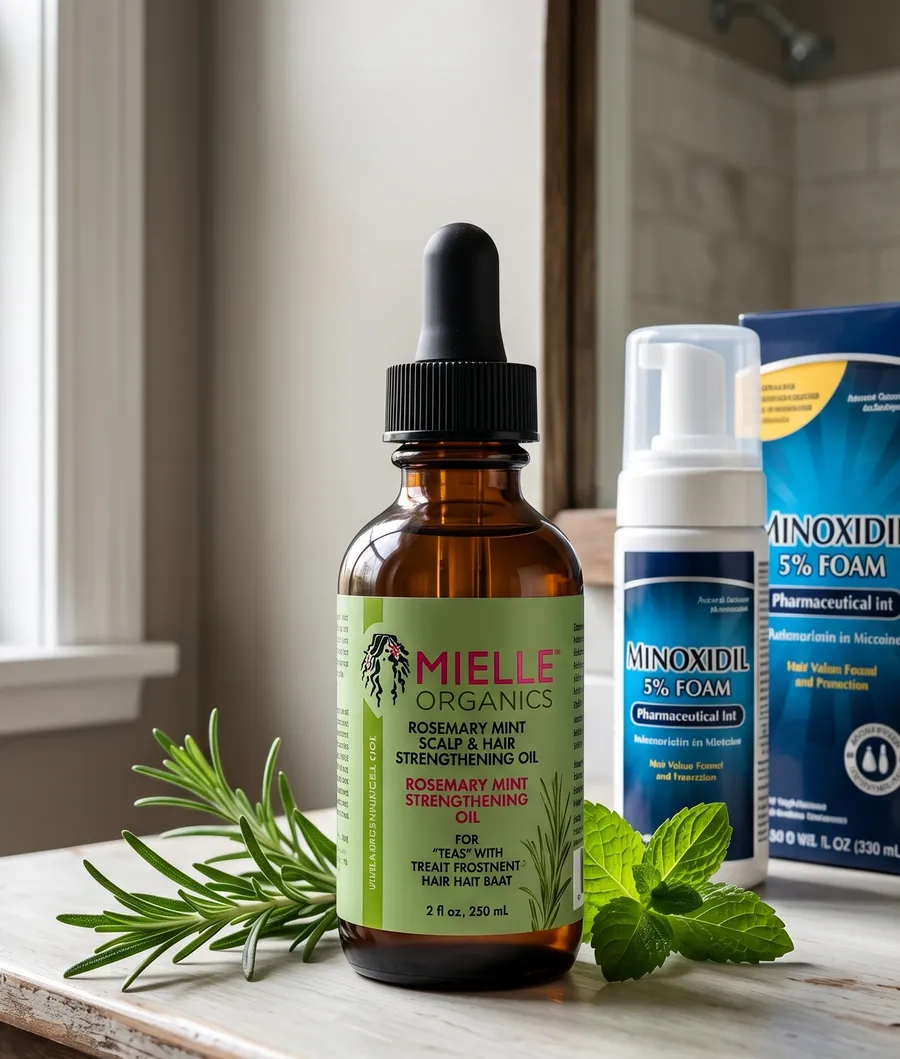
With rosemary oil and castor oil: fully compatible. Laser light doesn’t alter the active compounds in oils. Just keep a reasonable gap — no oil film on the scalp during a laser session, as it may reduce photon absorption.
With saw palmetto and natural DHT blockers: no interaction. Logical complementarity — they act on different pathways (hormonal vs photonic).
LLLT doesn’t compete with other treatments. It adds to them. That’s precisely what makes it a relevant tool in a multi-approach protocol — especially before considering a hair transplant, where a combined medical + LLLT protocol can stabilise progression for years.
Frequently asked questions
Can a laser comb actually regrow hair?
On follicles that are still active or partially miniaturised: yes, the clinical data supports this. It cannot reactivate follicles that have been fibrosed for years on a completely smooth area. It is more effective for prevention, stabilisation, and densification on areas where hair is thinning — than as a regrowth solution on long-bald zones.
Laser hair growth comb before and after: when do results appear?
Expect a minimum of 4 months for measurable densification. Optimal results are assessed at 9–12 months. If after 6 months of strict protocol you see no difference in your comparative photos, see a dermatologist — LLLT doesn’t work equally for all AGA types.
Can you use a laser comb while travelling?
Yes — this is one of the genuine advantages over a helmet. USB-C rechargeable models work with any power bank. A 5,000–10,000 mAh slim bank covers 3–4 sessions. Some models run on AA or AAA batteries — even simpler on the road, no cable needed.
What’s the real difference between a laser diode and an LED in these devices?
A real technical difference. A laser produces coherent, monochromatic, collimated light — photons travel “in phase” and penetrate tissue differently from a diffuse source. An LED produces incoherent light, broader in spectrum. Published clinical studies used lasers. LED phototherapy has its own protocols and studies, but they are not the same mechanisms or the same outcomes. Always verify “laser diode 650 nm” explicitly in the product specs before buying.
Are there known side effects from LLLT scalp treatment?
Based on available data: no documented side effects from correct use of 650 nm LLLT. The light is non-ionising, the power very low. One caution: never point the device directly at your eyes, same precaution as for any laser regardless of power. Relative contraindication: pacemaker — consult your cardiologist before use.
Is an infrared comb better than a red one?
The question usually rests on a false premise, because most combs advertised as infrared emit visible red light — if you can see the glow in the listing photos, it is red. Beyond that: near-infrared is a genuine photobiomodulation band, but the home-device trials for hair loss were run in the visible red at 655 nm, and near-infrared has mostly been studied alongside red rather than on its own. Buy on the printed wavelength and the named light source, not on the word in the title.
Is a laser comb effective for women?
Yes. HairMax received FDA clearance for women in 2011, and Lanzafame et al. (2014) ran the female arm of that work — 47 women, 16 weeks, a 37% rise in hair counts against a sham device. Jimenez et al. (2014) also included 141 women. For postpartum telogen effluvium: LLLT can support the follicle environment, but address the hormonal or nutritional root cause first.
HairMax vs iRestore: which one?
Different categories. HairMax is a targeted comb for specific zones — temples, part line, thinning crown. iRestore is a full-scalp helmet for total coverage. If your budget is under $300 and your concern is hairline/temples: HairMax. If you want complete hands-free coverage and can invest $700+: iRestore. Not competitors — different tools for different profiles.
Clinical sources
-
Lanzafame RJ, et al. — The growth of human scalp hair mediated by visible red light laser and LED sources in males. Lasers in Surgery and Medicine, 2013;45(8):487–495. PubMed
-
Lanzafame RJ, et al. — The growth of human scalp hair in females using visible red light laser and LED sources. Lasers in Surgery and Medicine, 2014;46(8):601–607. PubMed
-
Jimenez JJ, et al. — Efficacy and Safety of a Low-level Laser Device in the Treatment of Male and Female Pattern Hair Loss: a Multicenter, Randomized, Sham Device-Controlled, Double-Blind Study. American Journal of Clinical Dermatology, 2014. PubMed
-
Avci P, et al. — Low-level laser (light) therapy (LLLT) for treatment of hair loss. Lasers in Surgery and Medicine, 2014;46(2):144–151. PubMed
-
Hamblin MR. — Mechanisms and Mitochondrial Redox Signaling in Photobiomodulation. Photochemistry and Photobiology, 2018;94(2):199–212. PubMed
Medically reviewed by our internal trichology expert board.